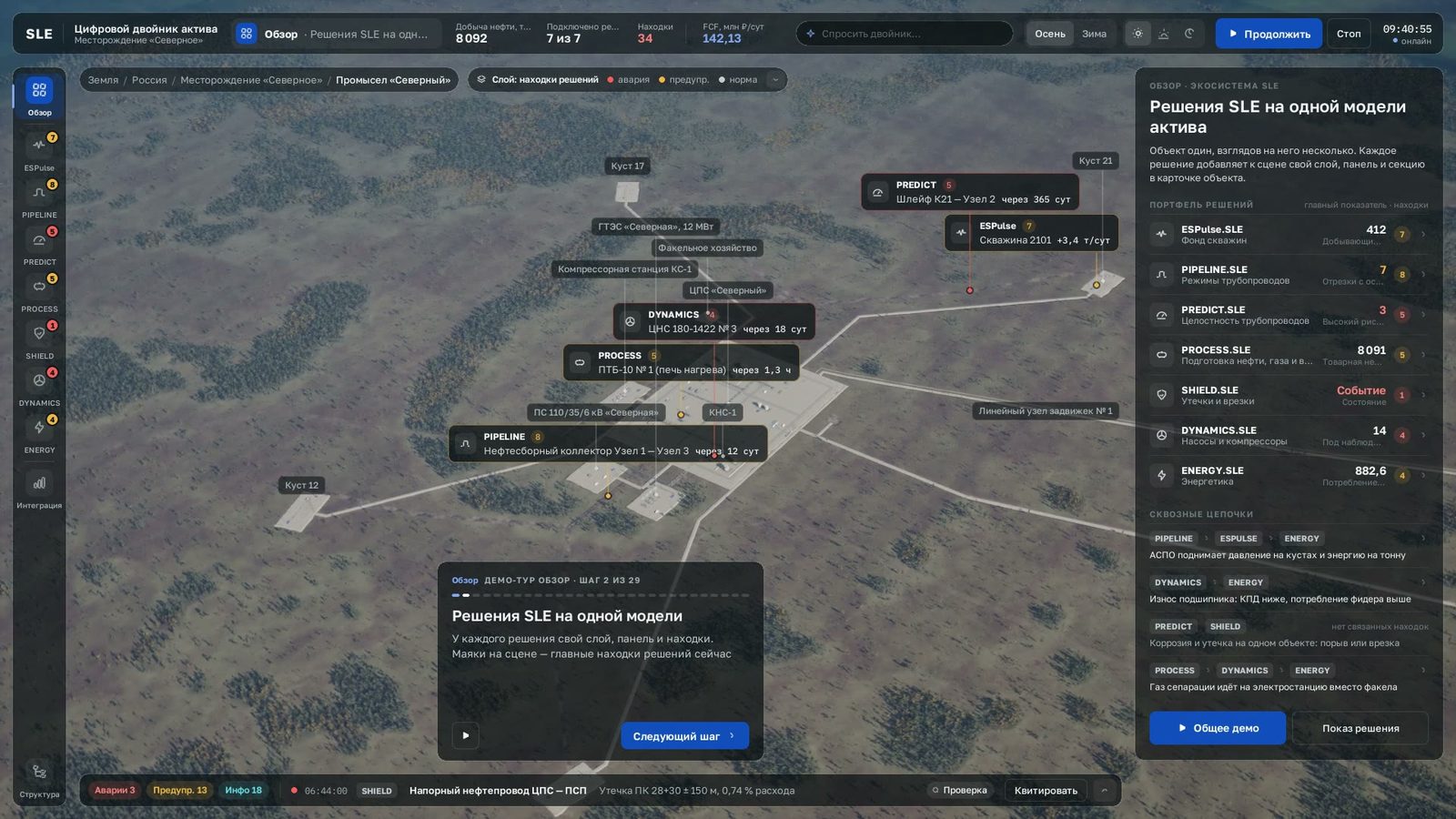
SLE solutions · the foundation is the asset digital twin
The asset digital twin — one front end for all SLE solutions
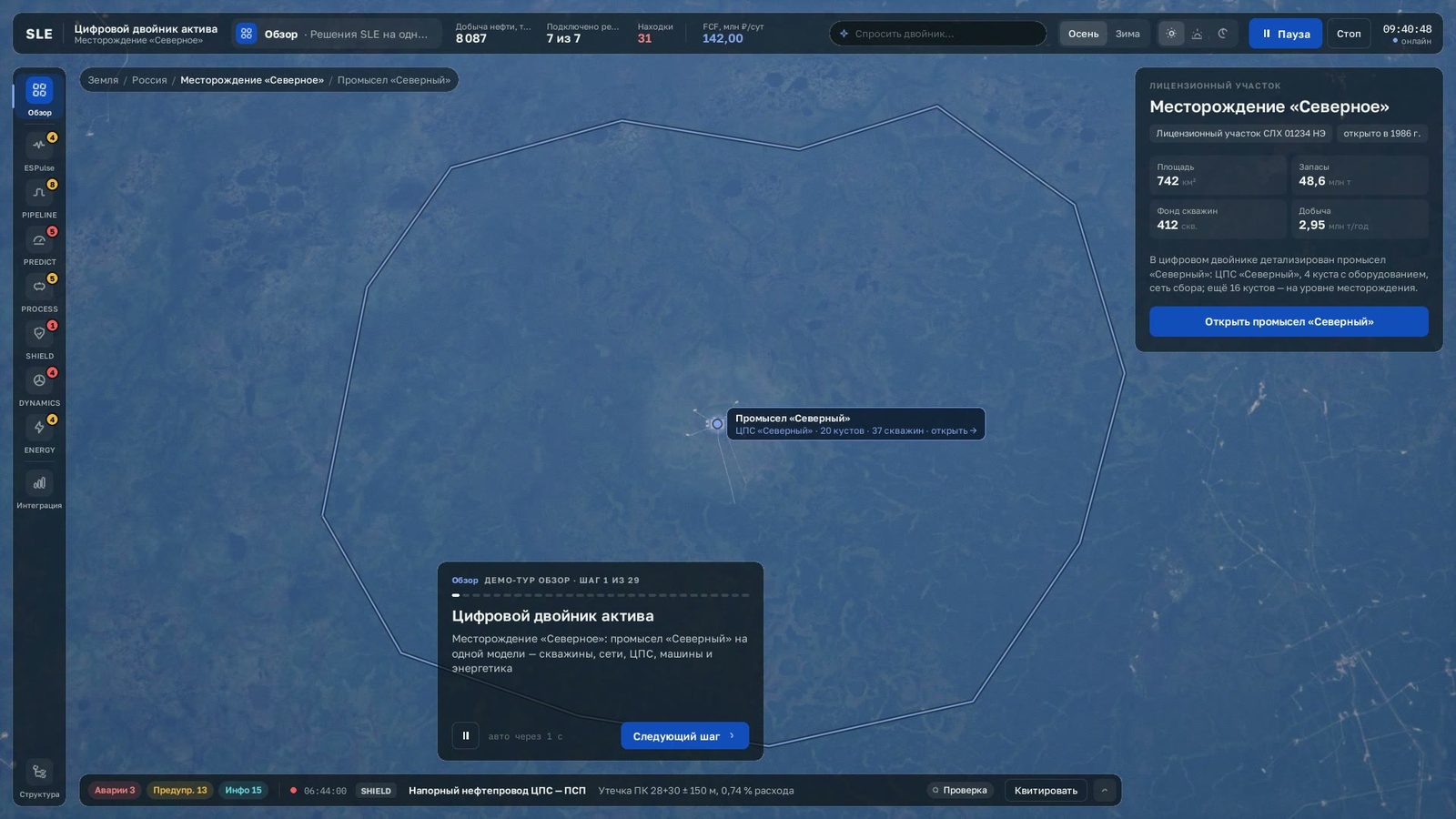
A photorealistic model of the field from the globe down to a unit component. One object — several views: every solution adds its own layer, panel and findings, and the effects come together in a cross-cutting value chain.
Overview · 6:47
Nine storylines at one field: from a waxed-up trunk line to a tap in the forest and the FCF bridge
An overview from the globe down to a unit component: every solution at its own object and the shared FCF bridge at the end.
Modules
Every solution gives the twin eight things
Passport
Solution name, section, icon, home camera view.
Object scope
Which object classes the module knows — the tree filter and icons.
Scene layer
Colour by object and along pipes, markers, labels, legend.
Panel and views
Key figures, lists, diagrams, profiles, tables.
Card section
A block about the object from the solution's point of view.
Findings
Forecasts, anomalies, events, recommendations with actions.
Levers and effects
What can be controlled and how it changes production, costs and risks.
Storylines
Demonstration stories: what happened and what the module found.
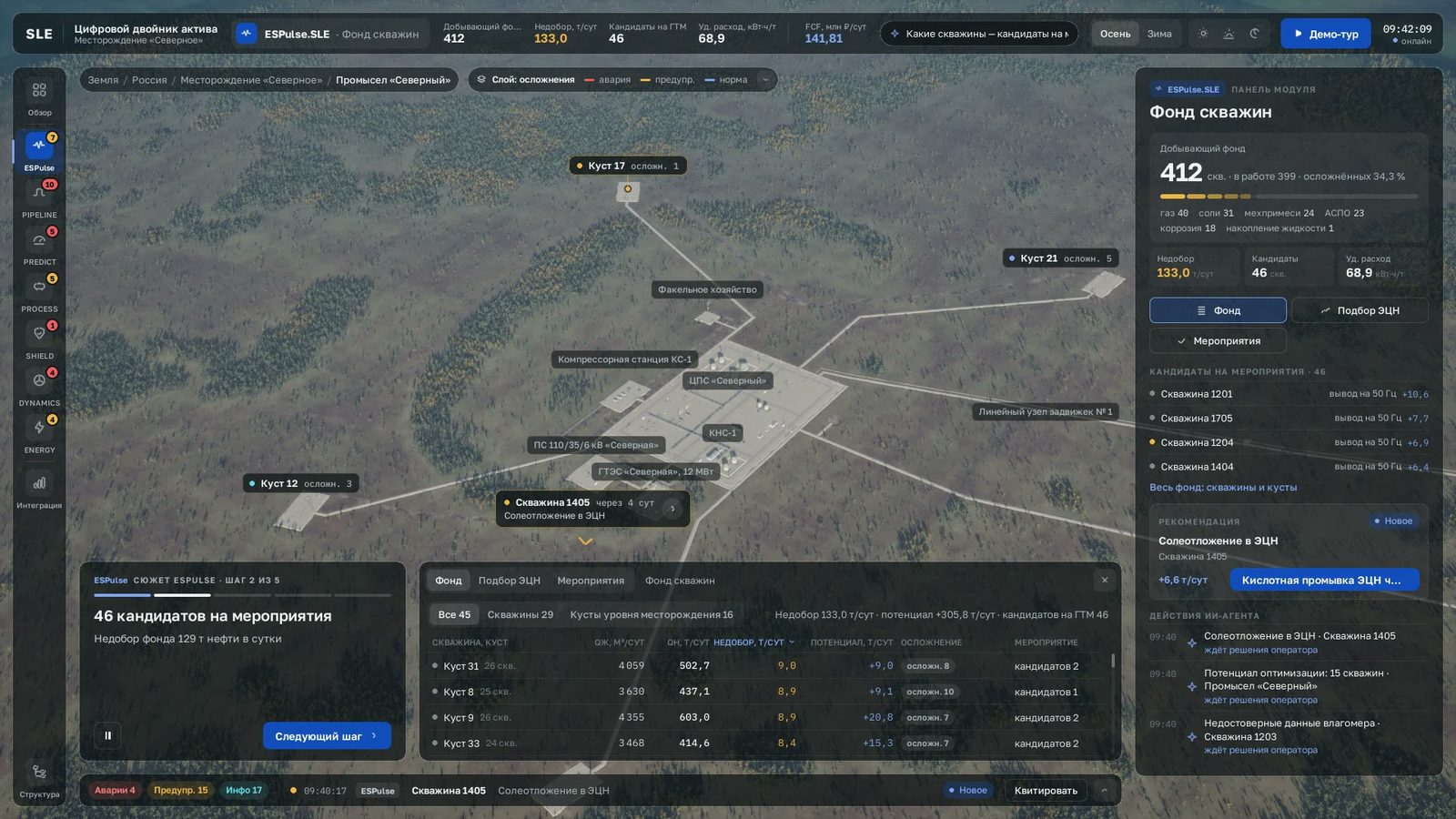
ESPulse.SLE
Well stock
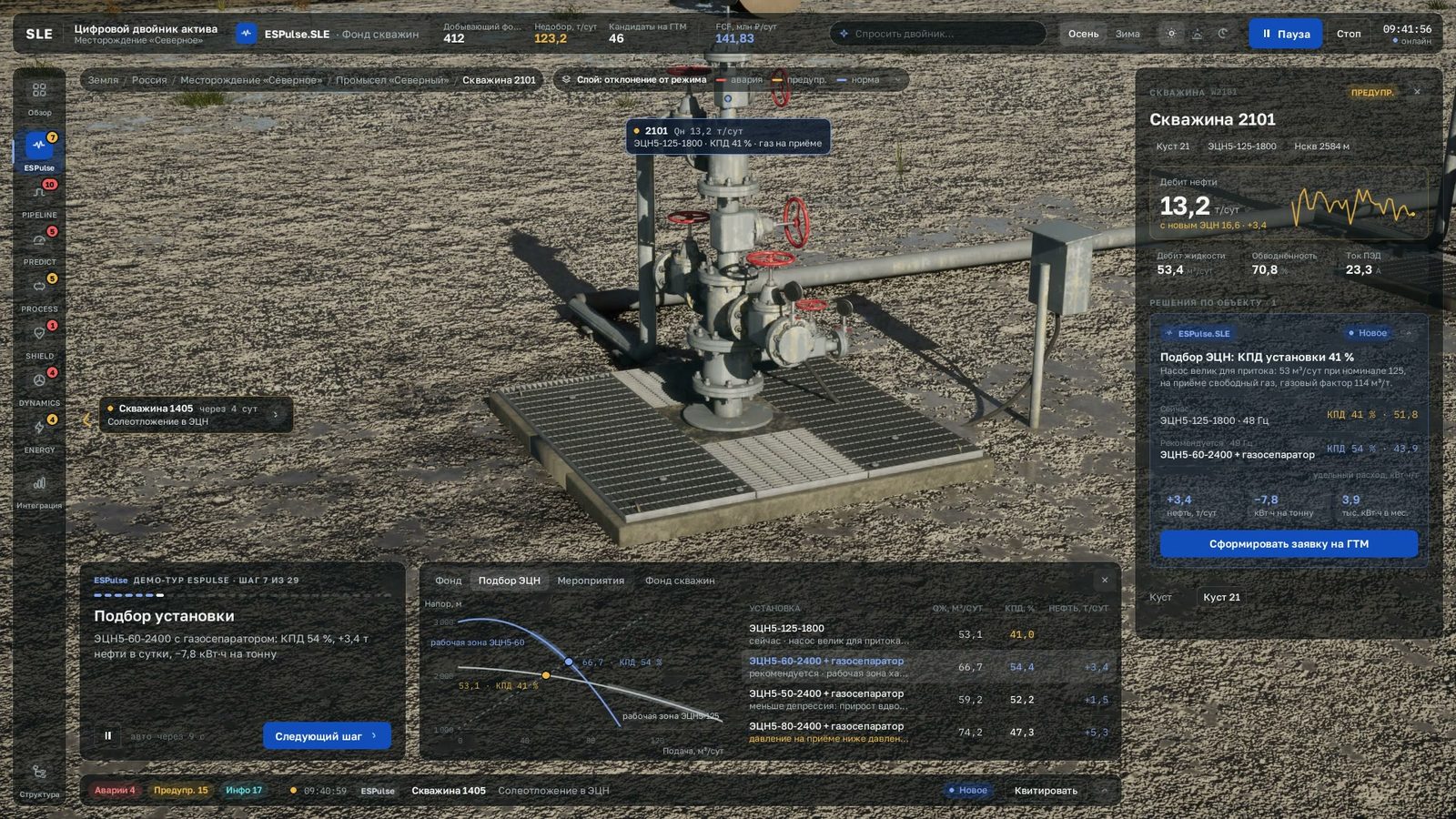
Well stock by shortfall and complications, ESP sizing, intervention candidates
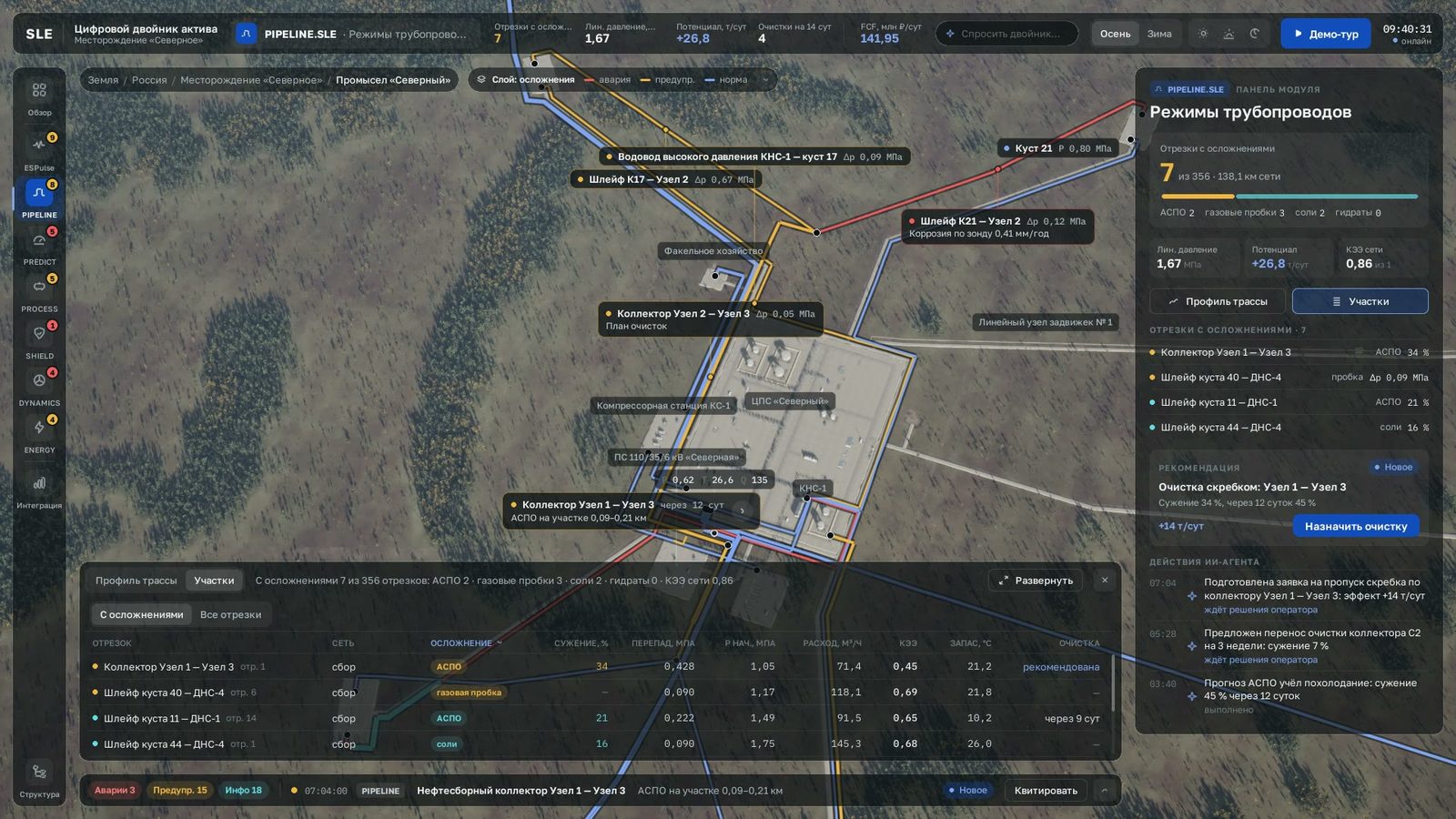
PIPELINE.SLE
Pipeline operating modes
A digital twin of the gathering network and water lines: complications, modes, pigging
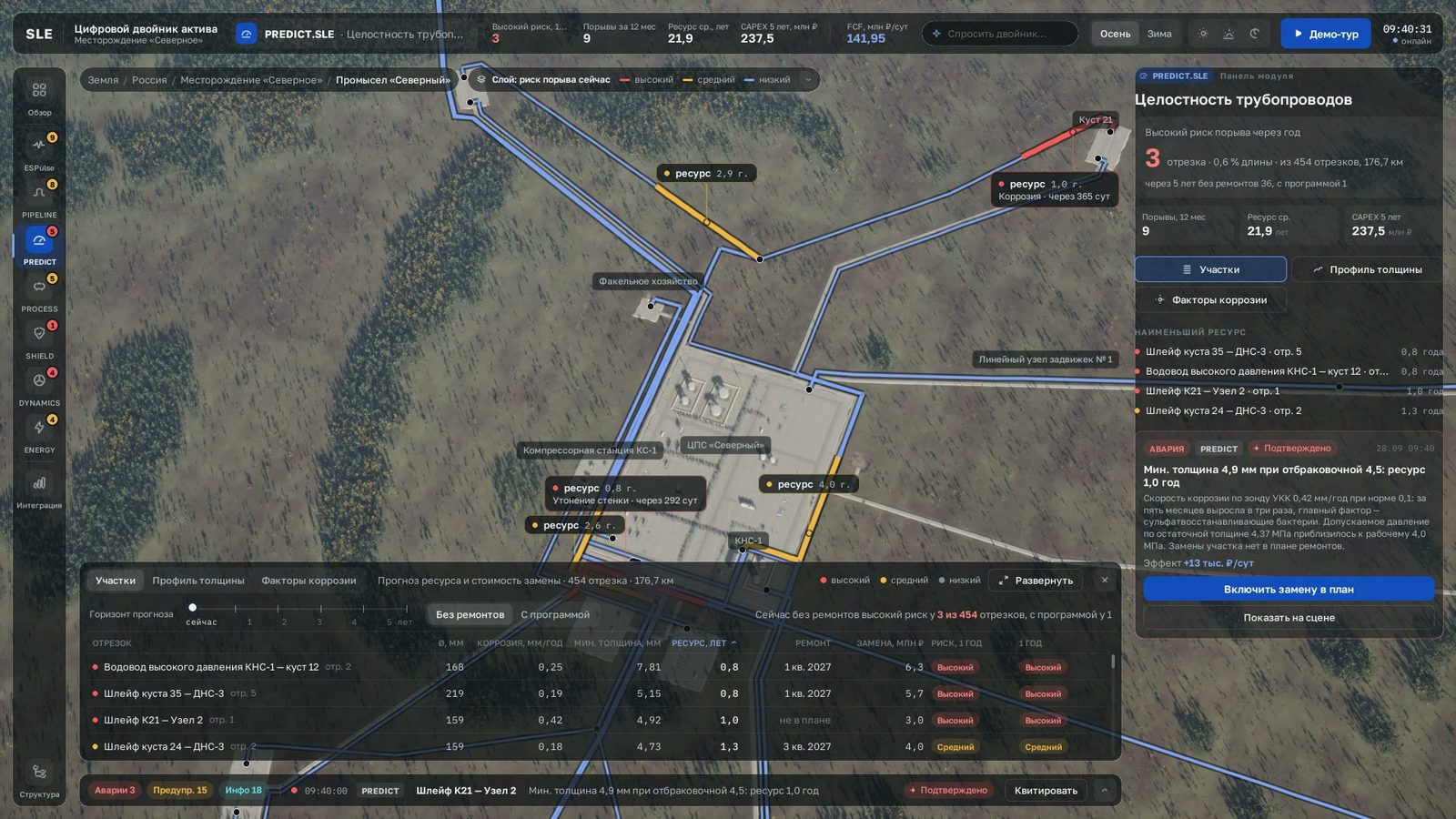
PREDICT.SLE
Pipeline integrity
Remaining life and rupture risk forecast for every section, repair programme
SHIELD.SLE
Leaks and taps
Detection of leaks and illegal taps from 0.5% of flow, with localisation
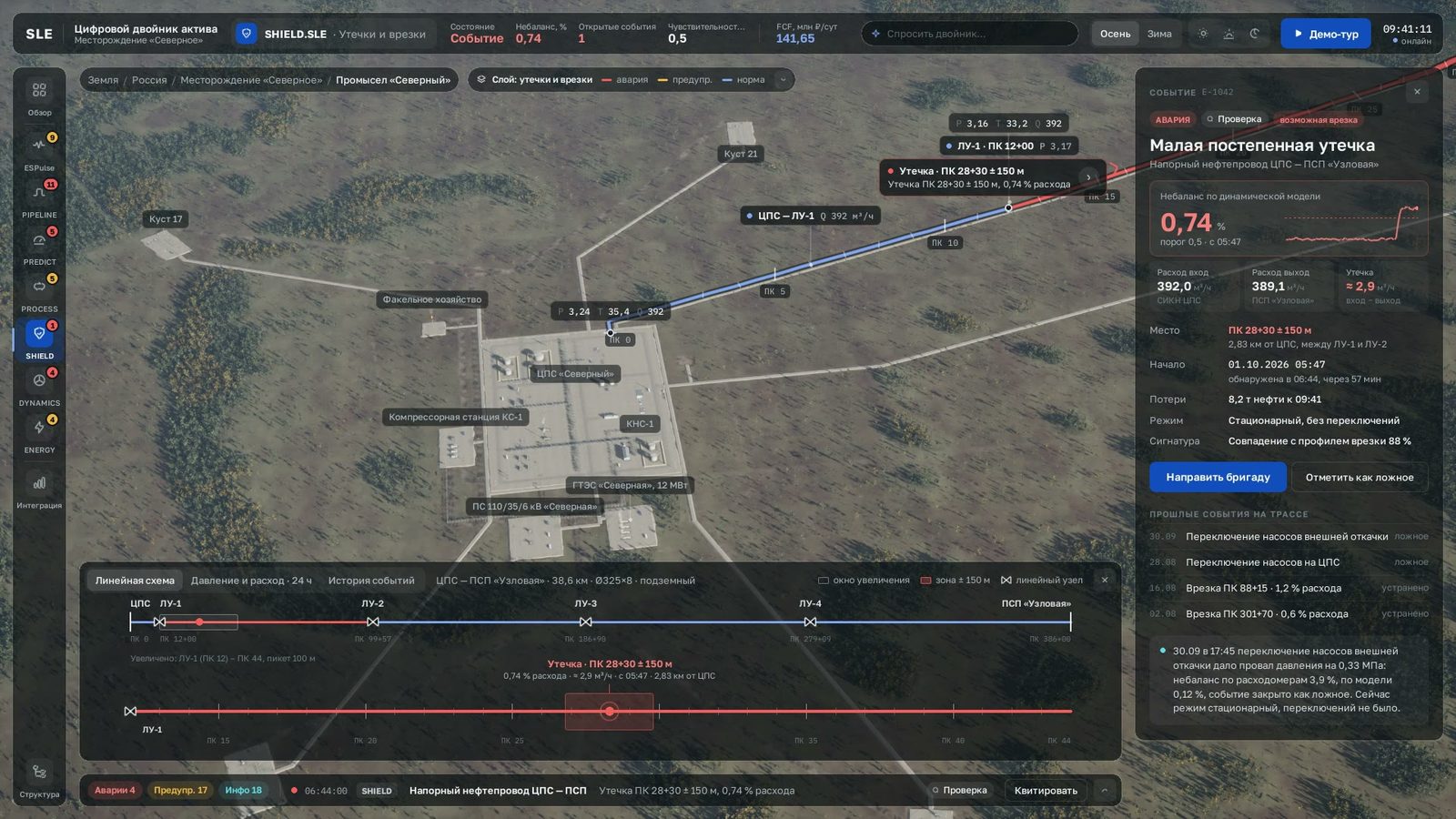
PROCESS.SLE
Oil, gas and water treatment
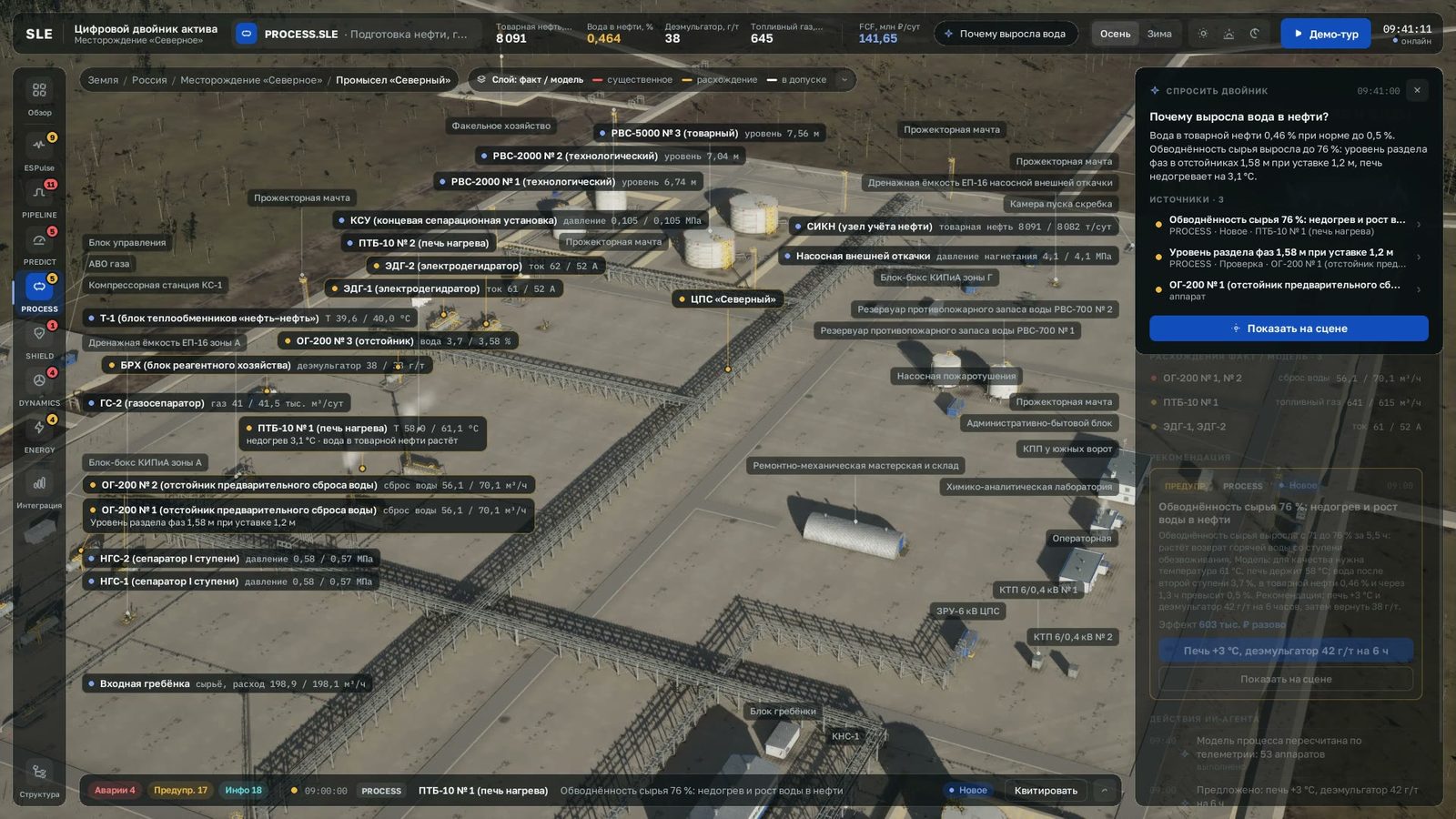
Process model versus actual for every CPF vessel, operating mode and chemicals by calculation
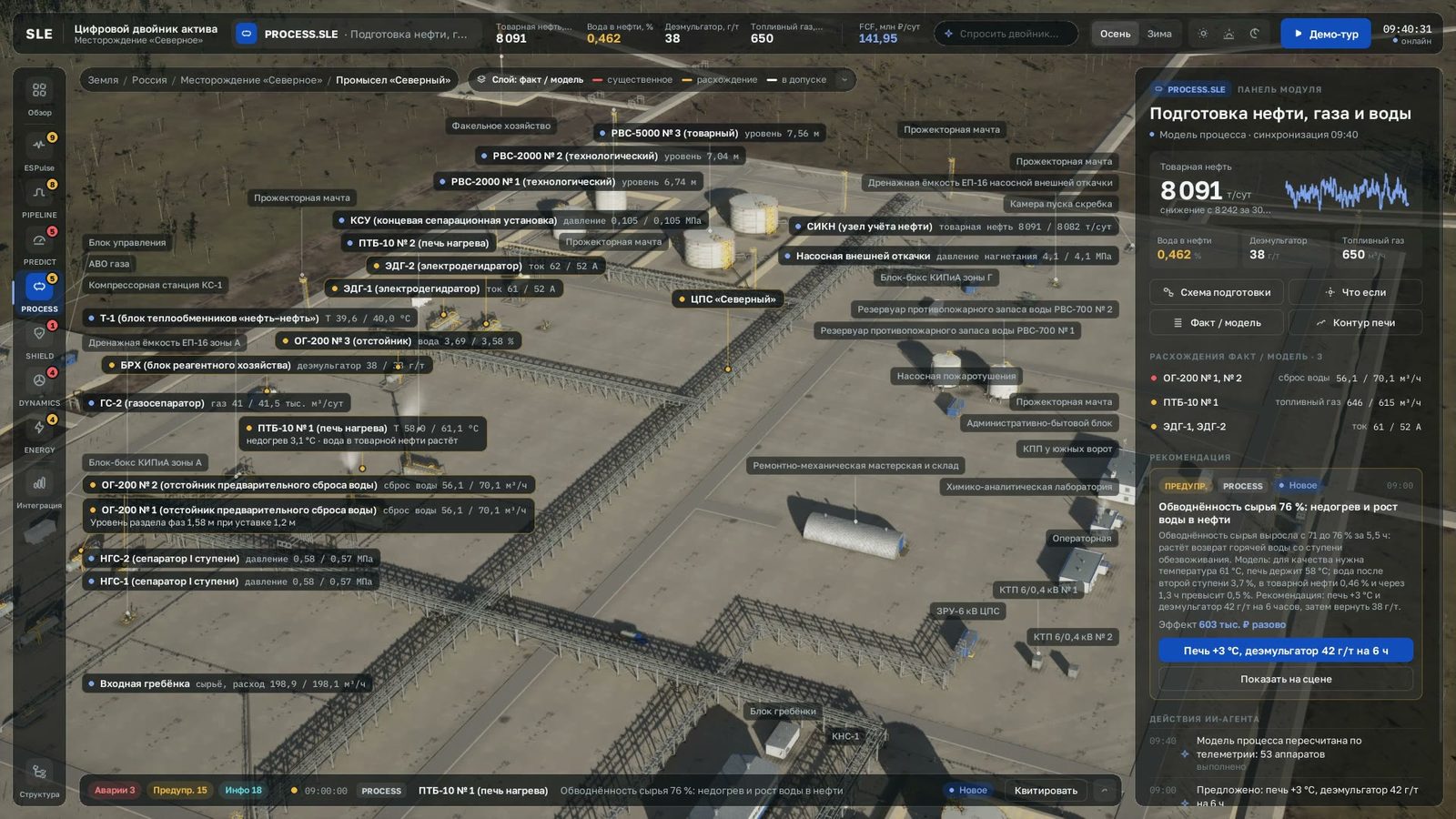
DYNAMICS.SLE
Pumps and compressors
Unit condition index, failure forecast by component, condition-based maintenance
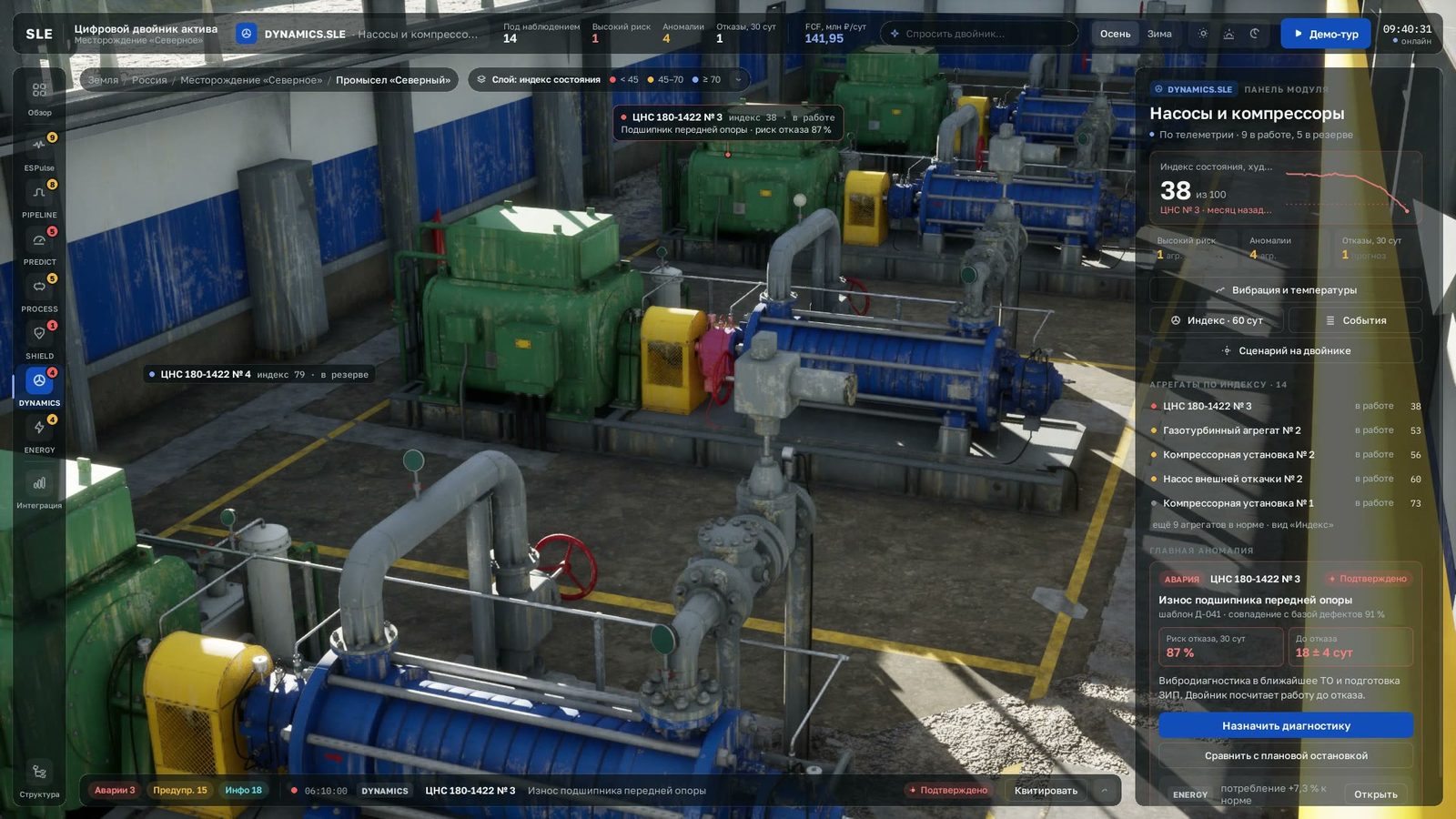
ENERGY.SLE
Power
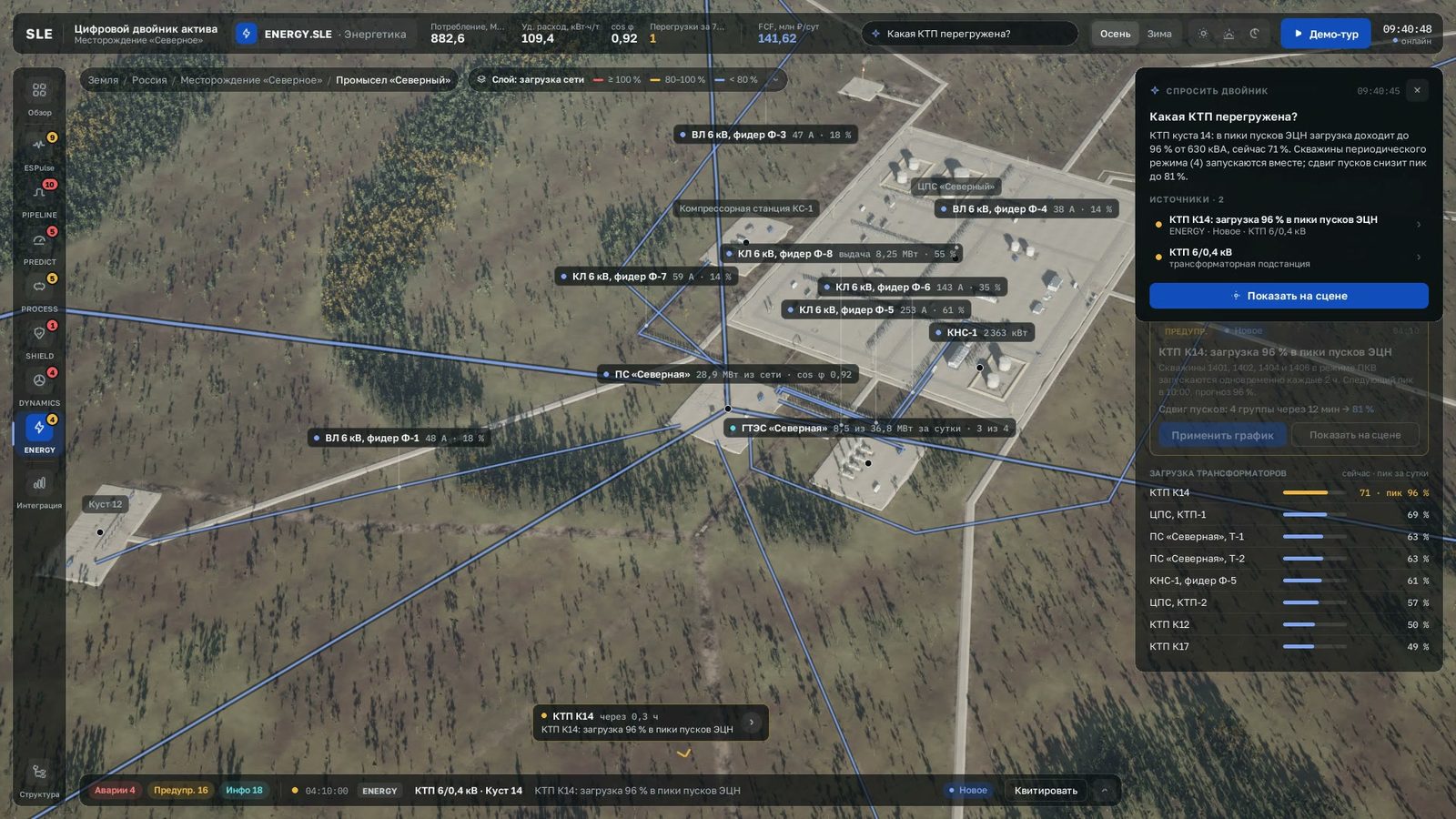
Grid load from the substation to the pad transformers, consumption forecast, peak shaving
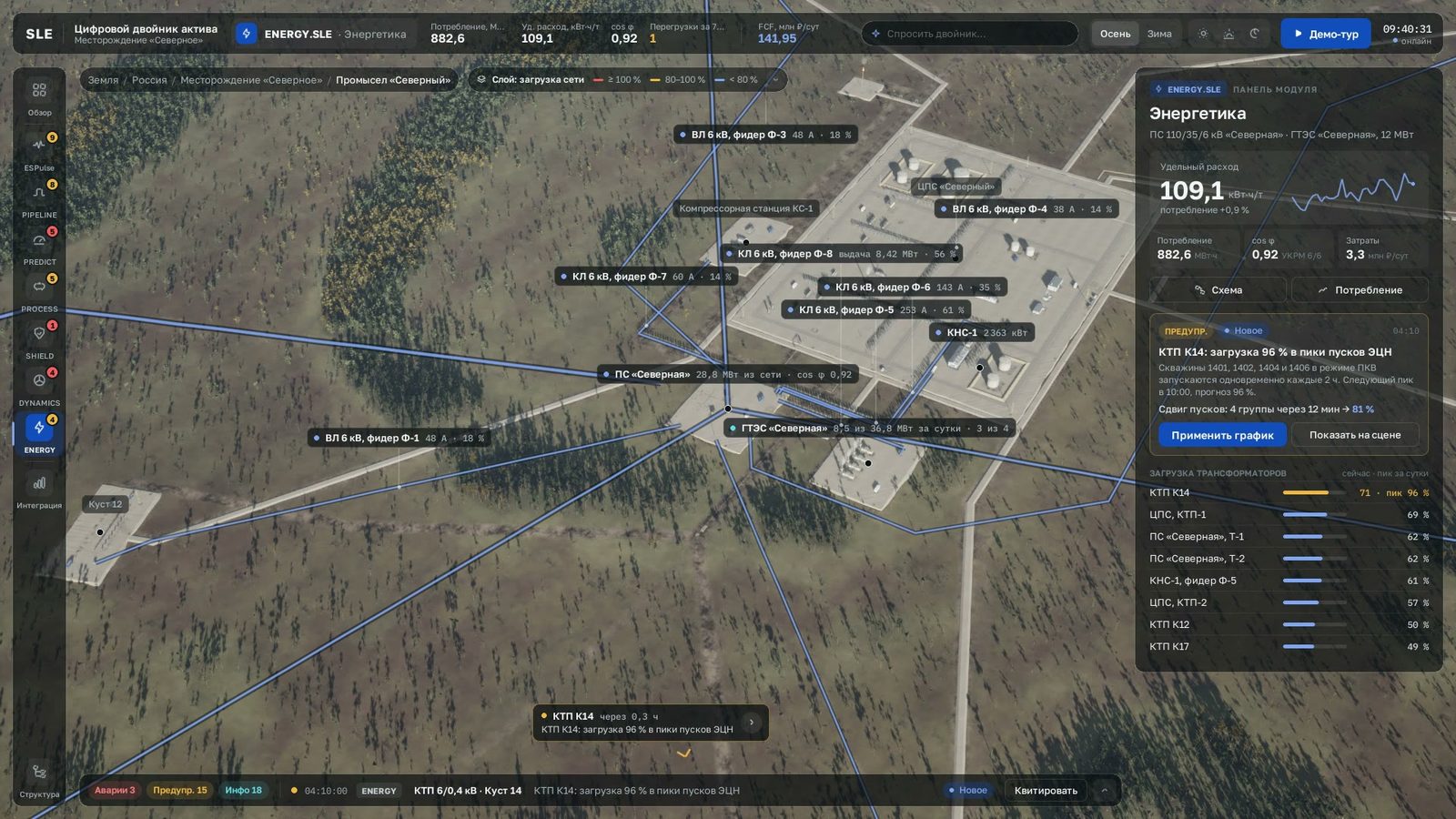
How the twin works
Three choices define the screen state: place, solution, time
Article: what an asset digital twin is and where to start →Place
Field → oilfield → site → object → unit → component
Camera cascade, asset tree, object card. Full 3D inside the detailed zone, markers and lines on satellite imagery for the rest of the licence area.
Solution
Which module to look at the asset through
The solutions dock on the left. A module switches on its scene layer, its panel, views and card section. The header shows the product and the section: “PIPELINE.SLE · Pipeline operating modes”.
Time
Now, history, forecast horizon
Seconds for a leak, days for pump wear, years for corrosion. A finding in the log stores all three and brings back the right module, object and camera in one click.
Core
What is common to all solutions lives in the core, so the modules look and behave the same
Asset model
One object register: class, name, parent, position, camera focus point. Two networks — hydraulic and electrical. Linear coordinates “section, from and to” are shared by the wax zone, the leak location and the thickness profile.
Tags and series
Telemetry on three time scales plus forecast series with a corridor. Scene labels carry values, not just names.
Findings log
Forecasts, anomalies, events and recommendations as one entity with the authoring module, a status and actions: new, under review, confirmed, false, resolved.
Scenarios and FCF
Levers from the modules add up into the free cash flow bridge. The Integration section shows each solution's contribution and asset development options.
Assistant · SLE LM Studio
Ask the twin
An “ask the twin” line in the header. The assistant works through the same screen state — place, solution, time — and reads the same findings and indicators the modules provide. The answer comes with sources and a “Show on scene” button: the camera flies to the object.
- Why has the water content in oil gone up?
Water in marketable oil is 0.46% against a limit of 0.5%. Feed water cut has risen to 76%: the interface level in the settlers is 1.58 m against a 1.2 m set-point, the heater is 3.1 °C short. - Where is the leak?
A leak on the export oil pipeline: chainage 28+30 ± 150 m, 2.83 km from the CPF. Imbalance 0.74% of flow, about 2.9 m³/h; the signature matches a tap at 88%. - What is wrong with pump No. 3?
CNS 180-1422 No. 3 at cluster pump station 1: drive-end bearing wear. Condition index 38 against a threshold of 45, vibration 7.2 mm/s. 18 ± 4 days to failure, probability 87%.
The large language model is deployed inside the customer's perimeter; data never leaves the company.
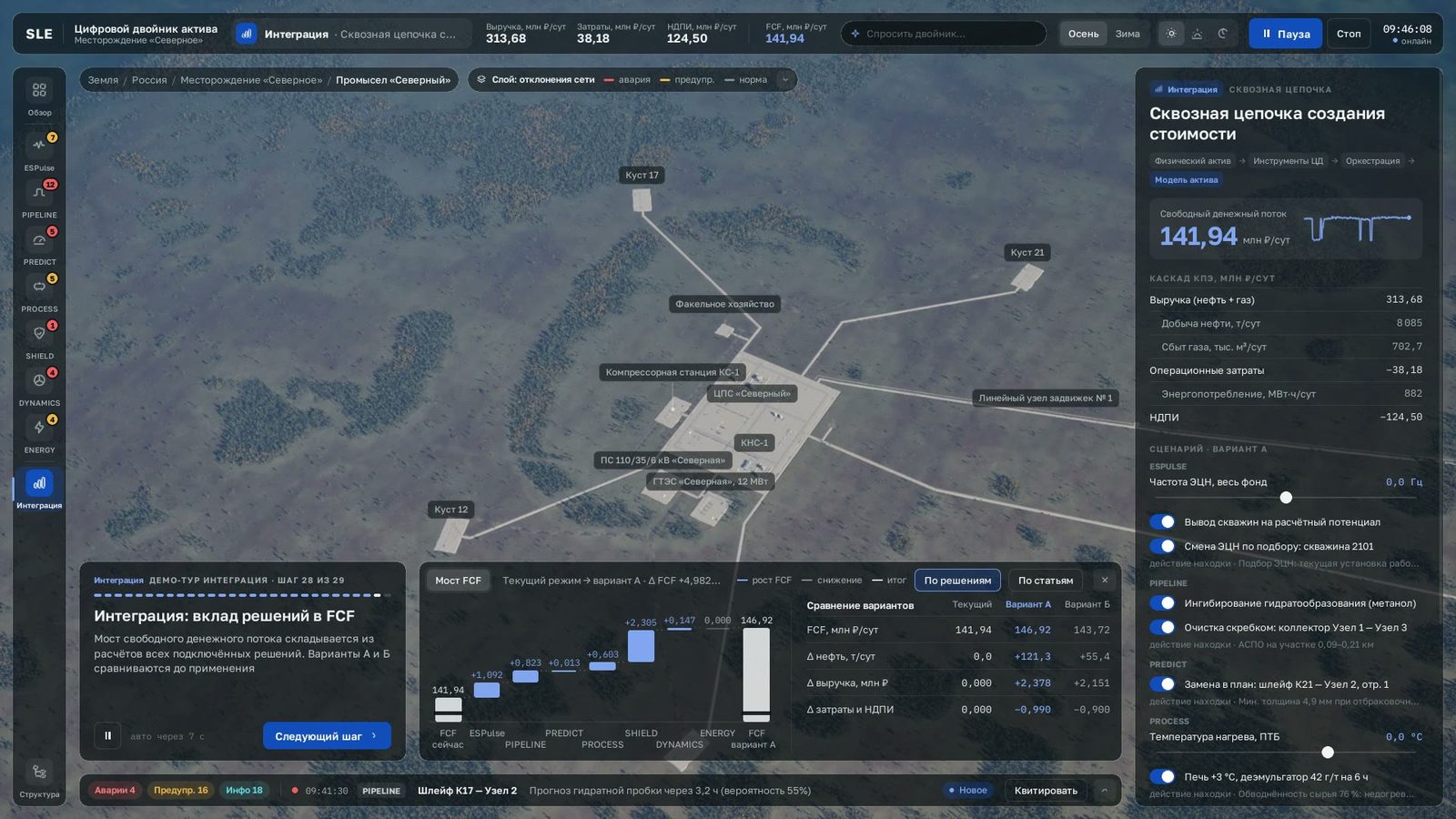
Integration
A cross-cutting value chain
Every module contributes levers and effects: extra production from pigging the trunk line, avoided injection downtime, chemical costs, own generation. The Integration section brings them into the FCF bridge and compares asset development options.
Levers are applied from cards and findings — with the same action the operator uses to accept a recommendation.
Inside the customer's perimeter
On-premise, Linux and Windows, model training inside the perimeter. A vendor-independent stack and a desktop application with the best possible image quality.
Integrations
DCS / SCADA, MES / ERP, LIMS, MDM; UniSim, HYSYS, DWSim, Symmetry, GIBBS and AEROSYM simulation engines — through the modules of the line.
Access and audit
Role model, action logging, finding statuses with author and time, compliance with the customer's security requirements.
Want to see your asset in one model?
We will show the twin at the demonstration field and then on your facility's data: the asset model, two or three solutions and the first cross-cutting chain.