Treatment
PROCESS.SLE — a digital twin of oil, gas and water treatment facilities
More marketable product with less chemicals and fuel gas.
PROCESS.SLEA module of the Solution Line Engineering ecosystem: it runs on the single asset model together with the other solutions and is linked to them by one data chain.About the digital twin →
Problem
When the feed composition changes, treatment modes break down: water in marketable oil rises, demulsifier and heater fuel gas are overused. Plant simulation models live apart from telemetry and go stale, and vessel bottlenecks are only seen after the fact.
Solution
PROCESS.SLE keeps a process model for every vessel of the CPF and compares it with actual data in real time: where they diverge, the vessel is highlighted. The what-if module calculates the operating mode for a feed change in advance and recommends heater temperature, chemical dosing and controller set-points; in an upset the twin gives the sequence of actions.
What the solution sees
One storyline at the demonstration field
STEP 01
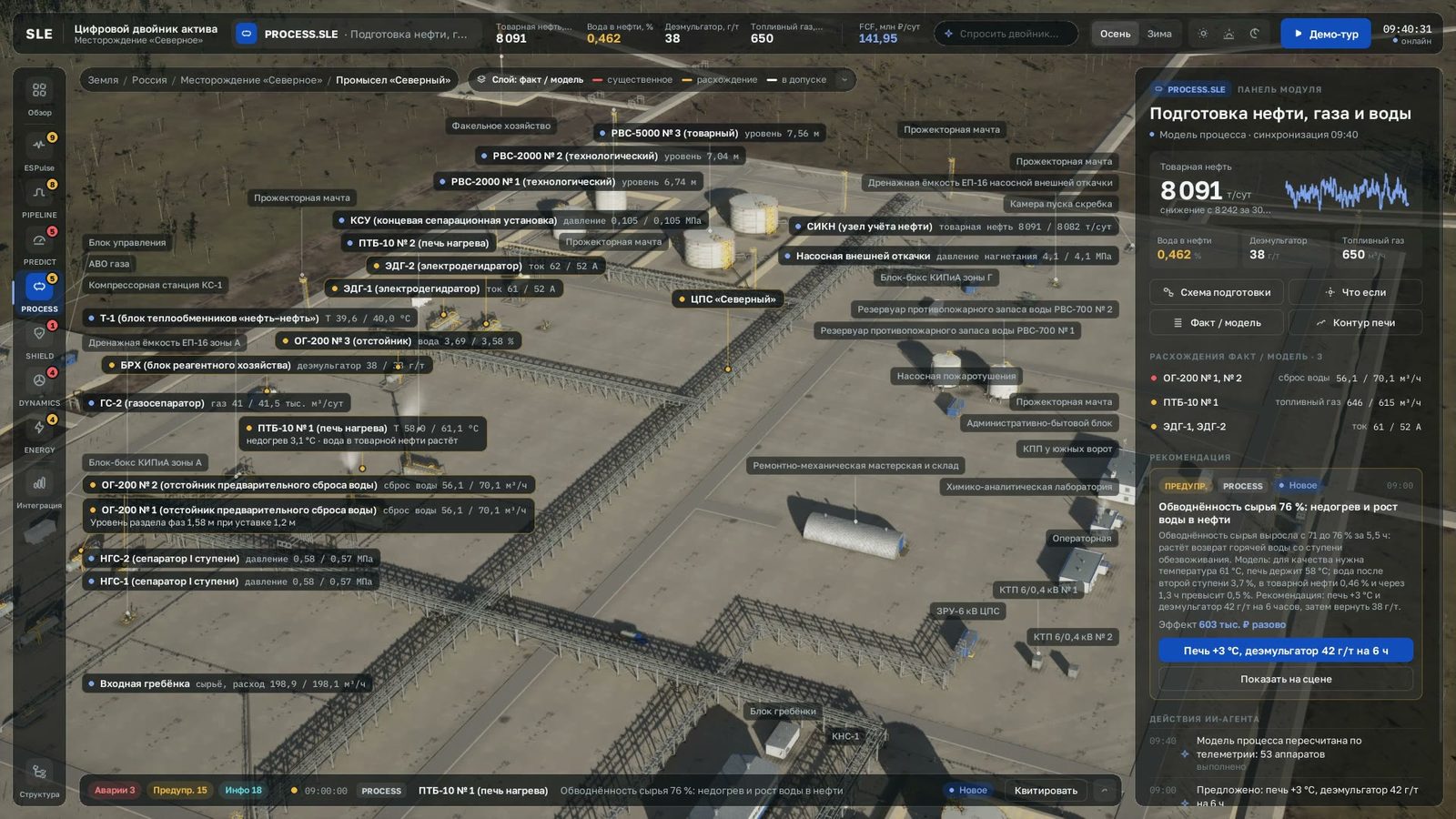
Model and actual by vessel
The settlers diverge the most: they separate a fifth less water than the model predicts. Water in marketable oil at 0.46% is approaching the 0.5 limit.
STEP 02
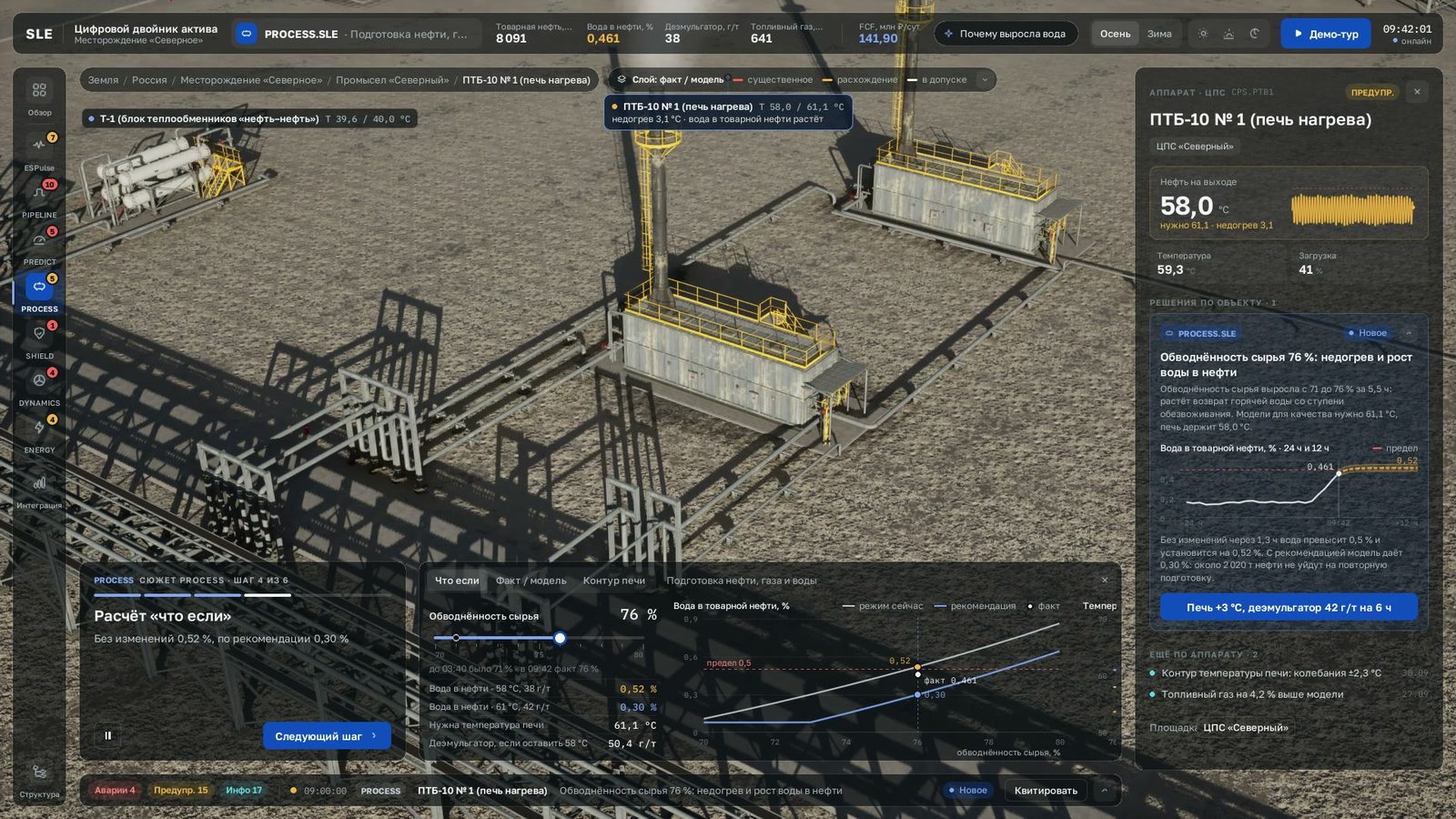
What-if calculation
Feed water cut has risen to 76%, the heater is 3 °C short. With no changes water in oil is 0.52%, with the twin's recommendation 0.30%.
STEP 03
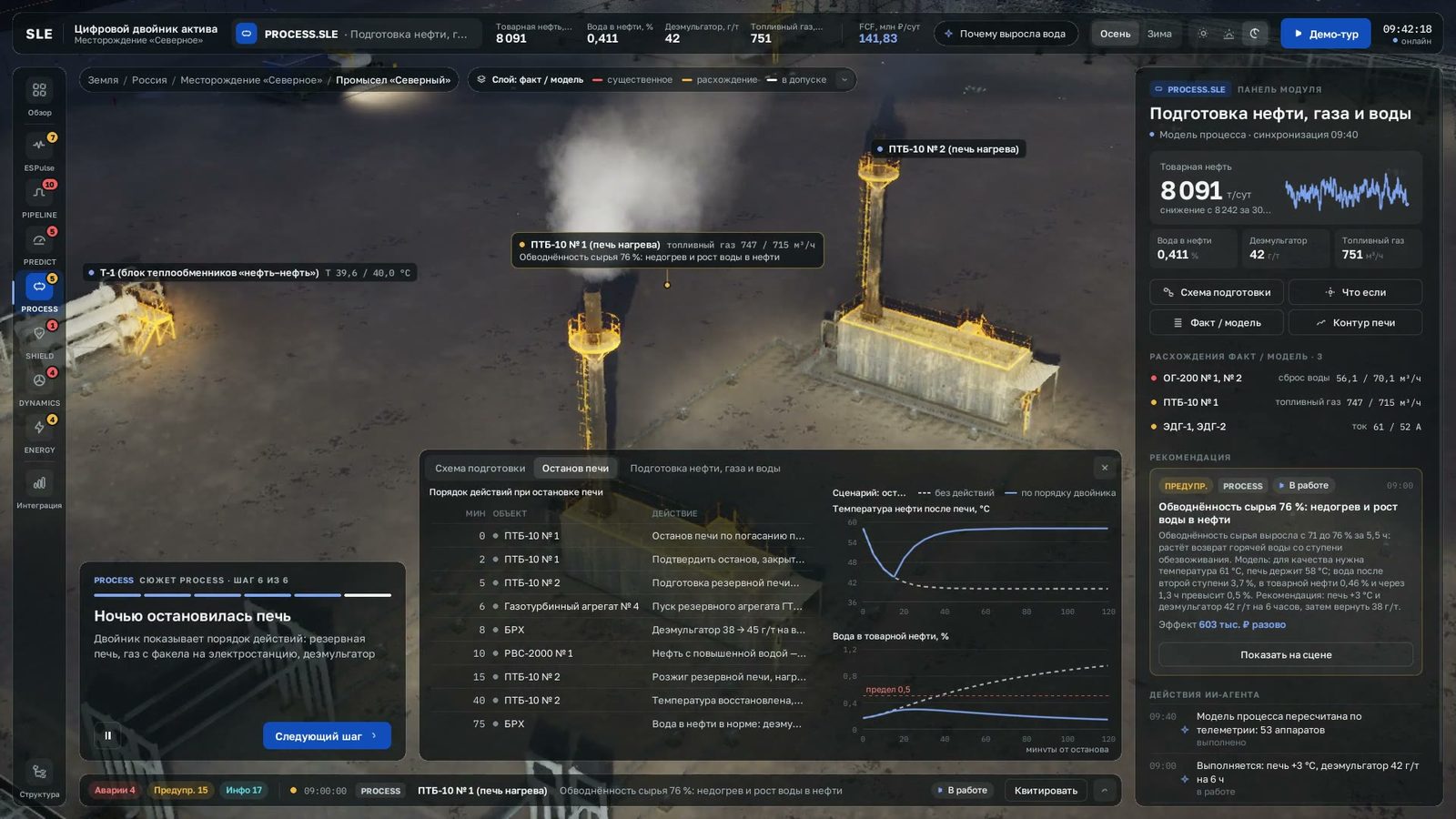
Night-time heater shutdown
The heater has stopped. The twin immediately gives the sequence of actions: start the standby heater, send the gas to the power plant rather than the flare, and add demulsifier.
Ask the twin
“Why has the water content in oil gone up?”
Water in marketable oil is 0.46% against a limit of 0.5%. Feed water cut has risen to 76%: the interface level in the settlers is 1.58 m against a 1.2 m set-point, the heater is 3.1 °C short.
An answer with sources; the “Show on scene” button flies the camera to the object.
How it works
01DataDCS telemetry, compositions from LIMS
02ModelSimulation engine self-calibrated against actual data
03AnalysisPlan versus actual by vessel, bottlenecks, diagnostics
04SolutionTemperature, chemicals, set-points, what-if scenario
05EffectMarketable oil yield, quality, gas and chemical consumption
Capabilities
Actual versus model
Deviation for every vessel — settlers, heaters, separators, electrostatic dehydrators — with a significance rating.
Mimic diagram and layer
A flow diagram with actual / model tags and vessel loading right on the 3D site.
What-if calculation
Feed water cut 71 → 76%: water in oil with no changes and with the twin's recommendation.
Operating mode recommendations
Heater +3 °C, demulsifier 42 g/t for 6 hours — with the expected outlet quality.
Upset conditions
A heater shutdown at night: start the standby, send gas to the power plant instead of the flare, add chemical.
Control loops
PID tuning before and after adjustment.
Simulation engines
UniSim, HYSYS, DWSim, Symmetry, GIBBS and AEROSYM through one interface.
Integrated model
Exchange of streams and phase equilibrium with the field model.
Business effect
+1,5%
marketable product yield over 6 months of pilot operation
case · CPF of a large field
−7%
demulsifier consumption with precise recommendations
case · CPF
−4,5%
plant energy consumption
case · CPF
Case figures were obtained in pilot operation and deployments at specific facilities; “demonstration on the twin” values come from the storyline at the model field.
Use cases
- Treatment plant process engineer sees the heater running below the model and a recommendation to raise the temperature with the expected yield gain.
- CPF manager runs the “water cut 71 → 76%” scenario and gets the mode and dosing in advance.
- I&C engineer receives recommended PID coefficients for the second-stage pressure controller.
Integrations
UniSim, HYSYS, DWSim, Symmetry, GIBBS and AEROSYM simulation engines; plant DCS; LIMS; integrated field model.
Cross-cutting chains
- DYNAMICS.SLE — Separator gas through the compressor
- ENERGY.SLE — Gas to the power plant instead of the flare
- Article: what an asset digital twin is and where to start →
We will show PROCESS.SLE on your asset's data
A demo online or on site; then a pre-project survey of one facility and pilot operation with a measured effect.