Rotating equipment
DYNAMICS.SLE — predictive analytics for pumps, compressors and gas compressor units
We see a developing defect before failure and move equipment to condition-based maintenance.
DYNAMICS.SLEA module of the Solution Line Engineering ecosystem: it runs on the single asset model together with the other solutions and is linked to them by one data chain.About the digital twin →
Problem
Unplanned shutdowns of pumps, compressors and gas compressor units cost more than any repair. Calendar-based maintenance replaces healthy parts and causes failures right after overhaul, while standard protections trip only once the defect has developed.
Solution
DYNAMICS.SLE combines vibration, temperatures and operating mode of every unit into a condition index, recognises the defect against a template library, predicts time to failure down to the component and compares two options on the twin — a planned shutdown versus running to failure. On the scene the pump house roof lifts off and the faulty component is highlighted right on the unit.
What the solution sees
One storyline at the demonstration field
STEP 01
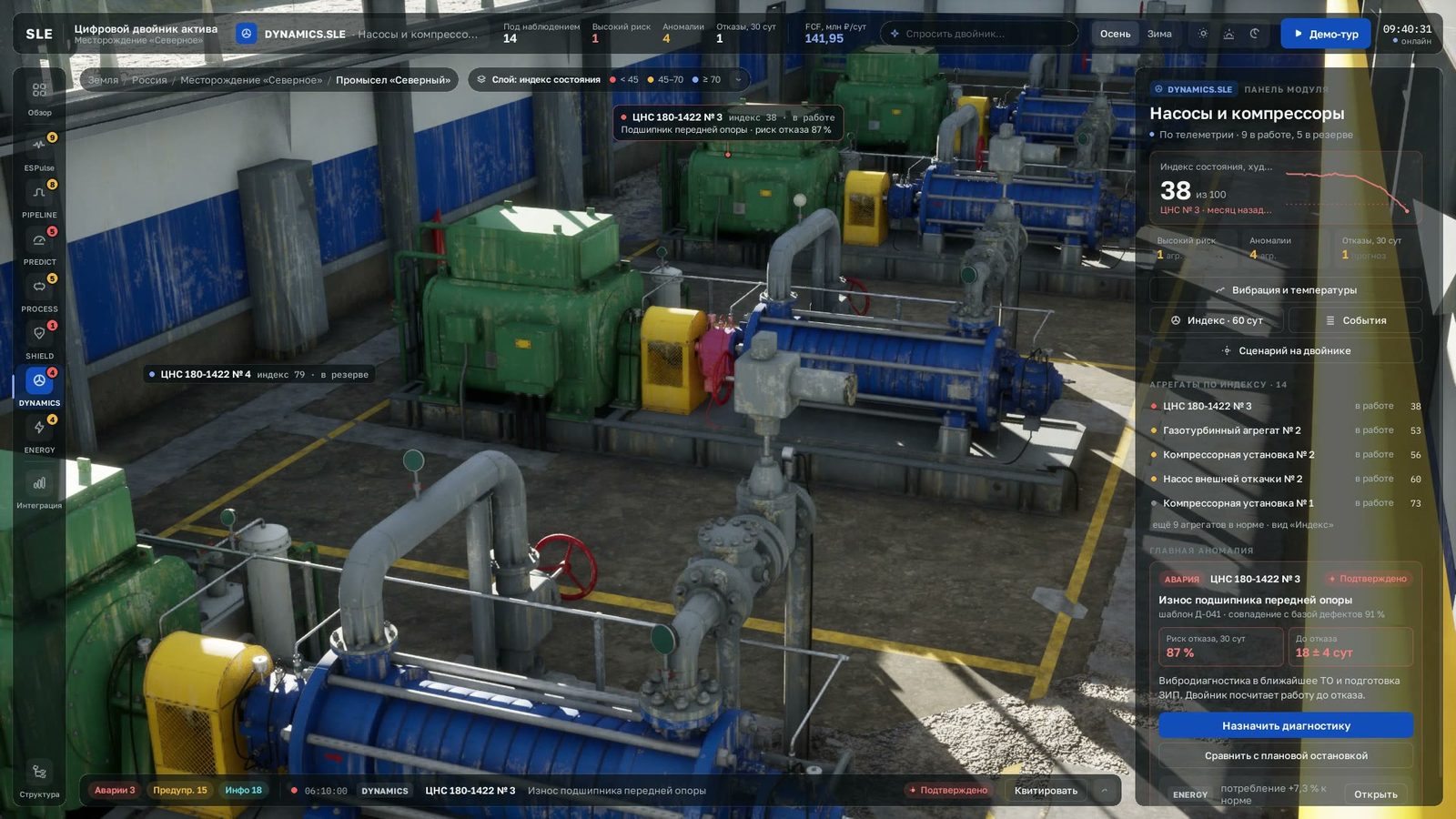
Units by index
14 units are monitored, one is at high risk: pump No. 3 of the cluster pump station. In a month its index fell from 74 to 38, below the 45 threshold.
STEP 02
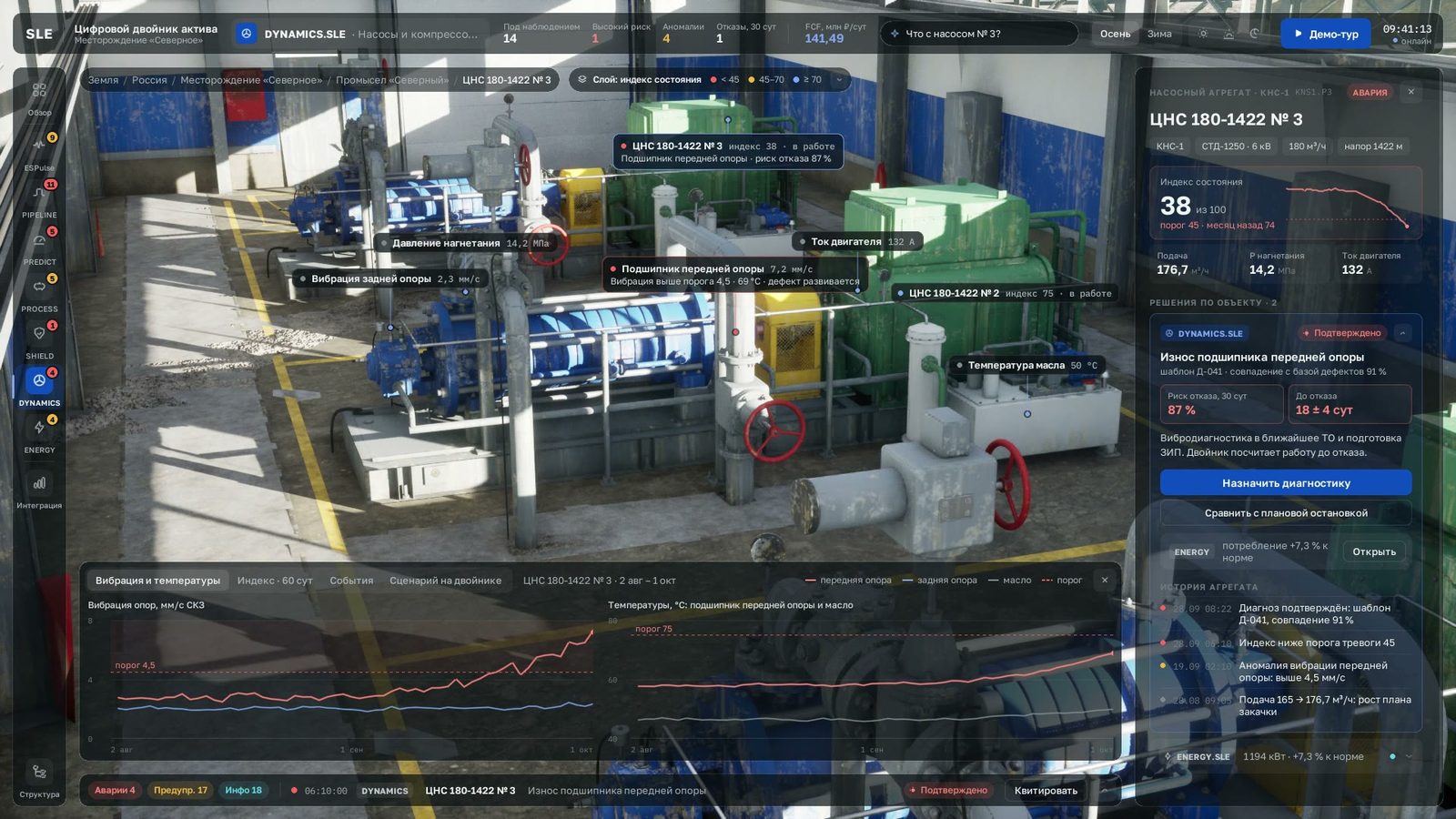
Drive-end bearing vibration
The pump house roof is lifted and the component is highlighted on the pump: 7.2 mm/s against a 4.5 threshold. The twin recognises bearing wear — a 91% match with the template, about 18 days to failure.
STEP 03
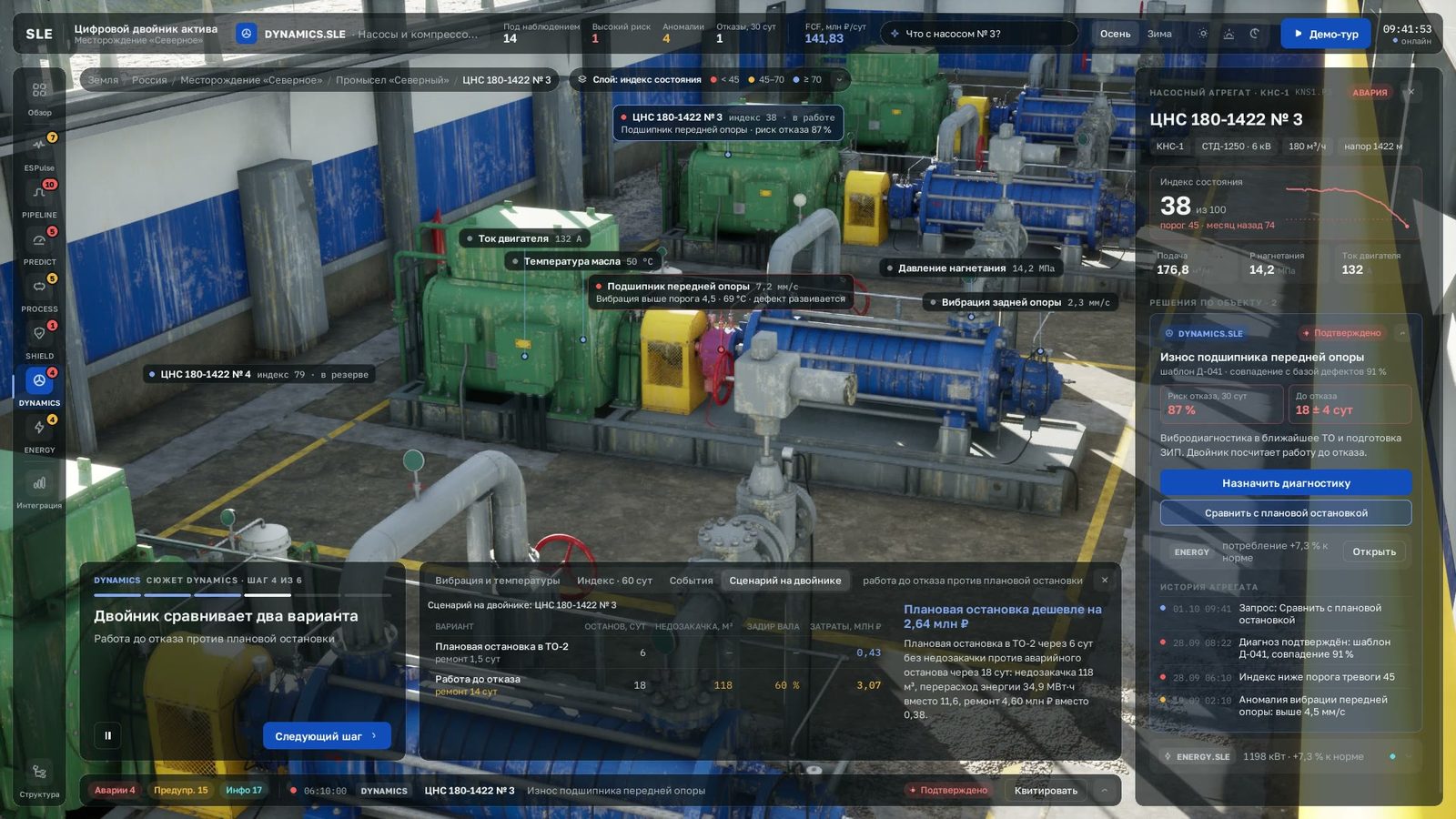
Two options on the twin
A planned shutdown at the next service costs RUB 0.43 mln, running to failure RUB 3.07 mln. The inspection is scheduled, standby pump No. 4 took the load, injection is not interrupted.
Ask the twin
“What is wrong with pump No. 3?”
CNS 180-1422 No. 3 at cluster pump station 1: drive-end bearing wear. Condition index 38 against a threshold of 45, vibration 7.2 mm/s. 18 ± 4 days to failure, probability 87%.
An answer with sources; the “Show on scene” button flies the camera to the object.
How it works
01DataVibration, temperatures, pressures and modes from the DCS
02IndexIntegral condition parameter per unit
03DiagnosisAnomaly and match against the defect library
04ForecastTime to failure and probable cause
05SolutionInspection or a scenario: shutdown versus running to failure
Capabilities
Condition index
One indicator per unit over 60 days with an alarm threshold.
Unit components
Motor, coupling, bearings, pump, oil system — value tags on the 3D model.
Defect recognition
A 91% match with the “bearing shell wear” template; up to 80% of developing defects are recognised.
Failure forecast
18 ± 4 days to failure with 87% probability.
Scenario on the twin
A planned shutdown at the next service versus running to failure — in money.
Scheduling an inspection
The standby unit takes the load; injection is not interrupted.
Event history
Requests, inspections and repairs for every unit.
Link to power
A worn pump draws more power — ENERGY.SLE sees it.
Business effect
+12%
equipment productive time
case · water injection pumps
−65%
emergency shutdowns after moving to condition-based maintenance
case · water injection pumps
up to 80%
of developing defects recognised
with the false alarm rate under control
Case figures were obtained in pilot operation and deployments at specific facilities; “demonstration on the twin” values come from the storyline at the model field.
Use cases
- Reliability engineer opens the anomaly card: bearing, 18-day forecast — and schedules vibration diagnostics for the next service.
- Shop mechanic gets an early anomaly alert and orders spare parts before the failure.
- Chief mechanical engineer plans repairs by condition and tracks the fleet's productive time.
Integrations
DCS / SCADA, vibration monitoring systems, MES; defect libraries; ENERGY.SLE for unit power consumption.
Cross-cutting chains
- ENERGY.SLE — Feeder consumption under wear
- PROCESS.SLE — Separator gas compressor
- Article: what an asset digital twin is and where to start →
We will show DYNAMICS.SLE on your asset's data
A demo online or on site; then a pre-project survey of one facility and pilot operation with a measured effect.