Pipelines
PREDICT.SLE — pipeline integrity and remaining-life forecast
We forecast the life of every section and plan repairs and CAPEX years ahead.
PREDICT.SLEA module of the Solution Line Engineering ecosystem: it runs on the single asset model together with the other solutions and is linked to them by one data chain.About the digital twin →
Problem
The data for a forecast already exists: in-line inspection, ultrasonic thickness measurement, corrosion monitoring, operating modes and rupture history. It lives in different systems, so repairs and replacements are scheduled by regulatory term rather than actual condition.
Solution
PREDICT.SLE brings inspection and operating data together by section, estimates the corrosion rate, forecasts remaining life and allowable pressure, recolours the network over a 1–5-year horizon in two variants — without repairs and with the programme — and costs the replacements. This is how a risk-based repair programme is formed.
What the solution sees
One storyline at the demonstration field
STEP 01
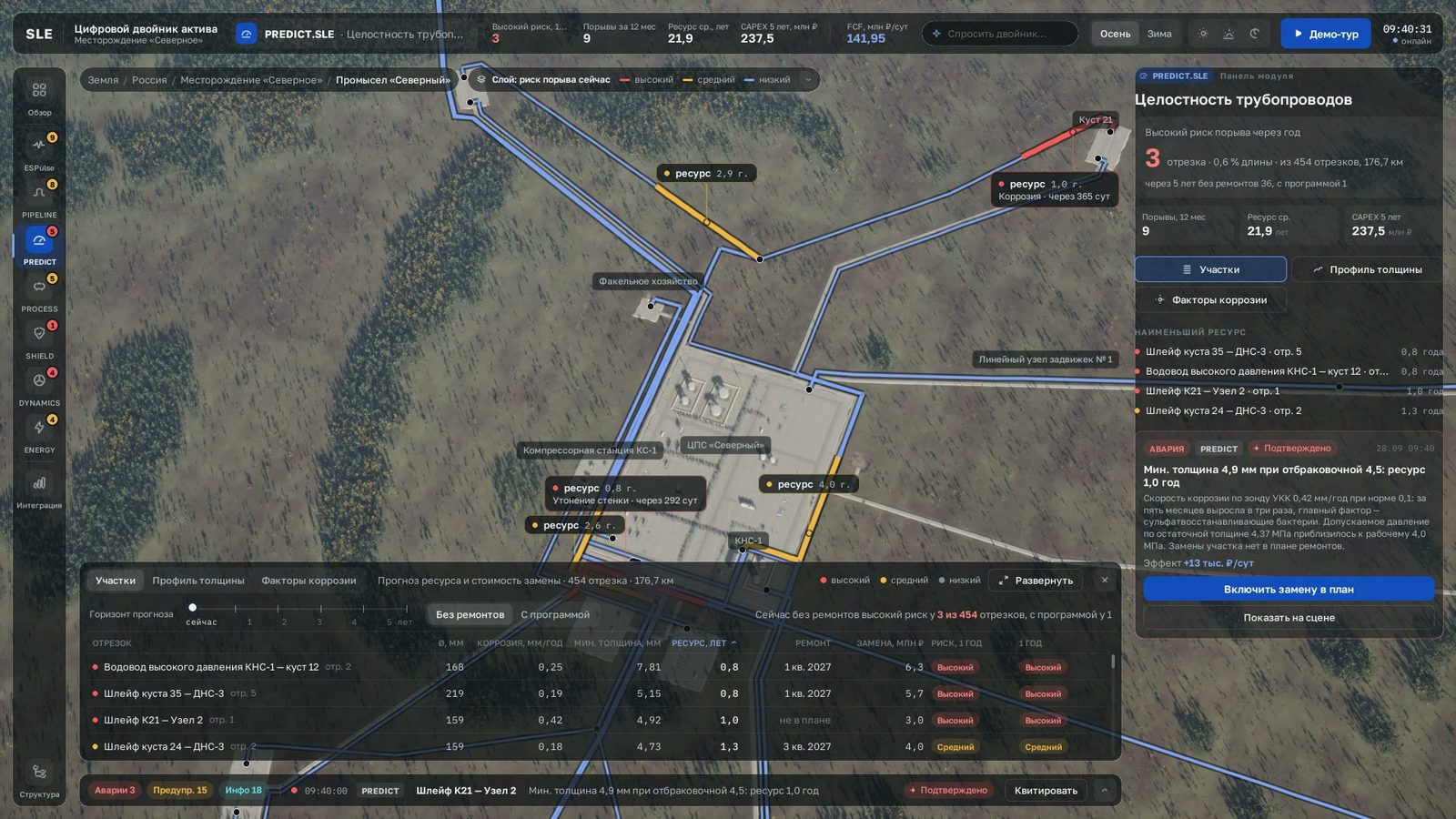
Rupture risk across the network
Three sections are already at high risk, nine ruptures in a year. In three years without repairs 15 of 454 sections will be at high risk.
STEP 02
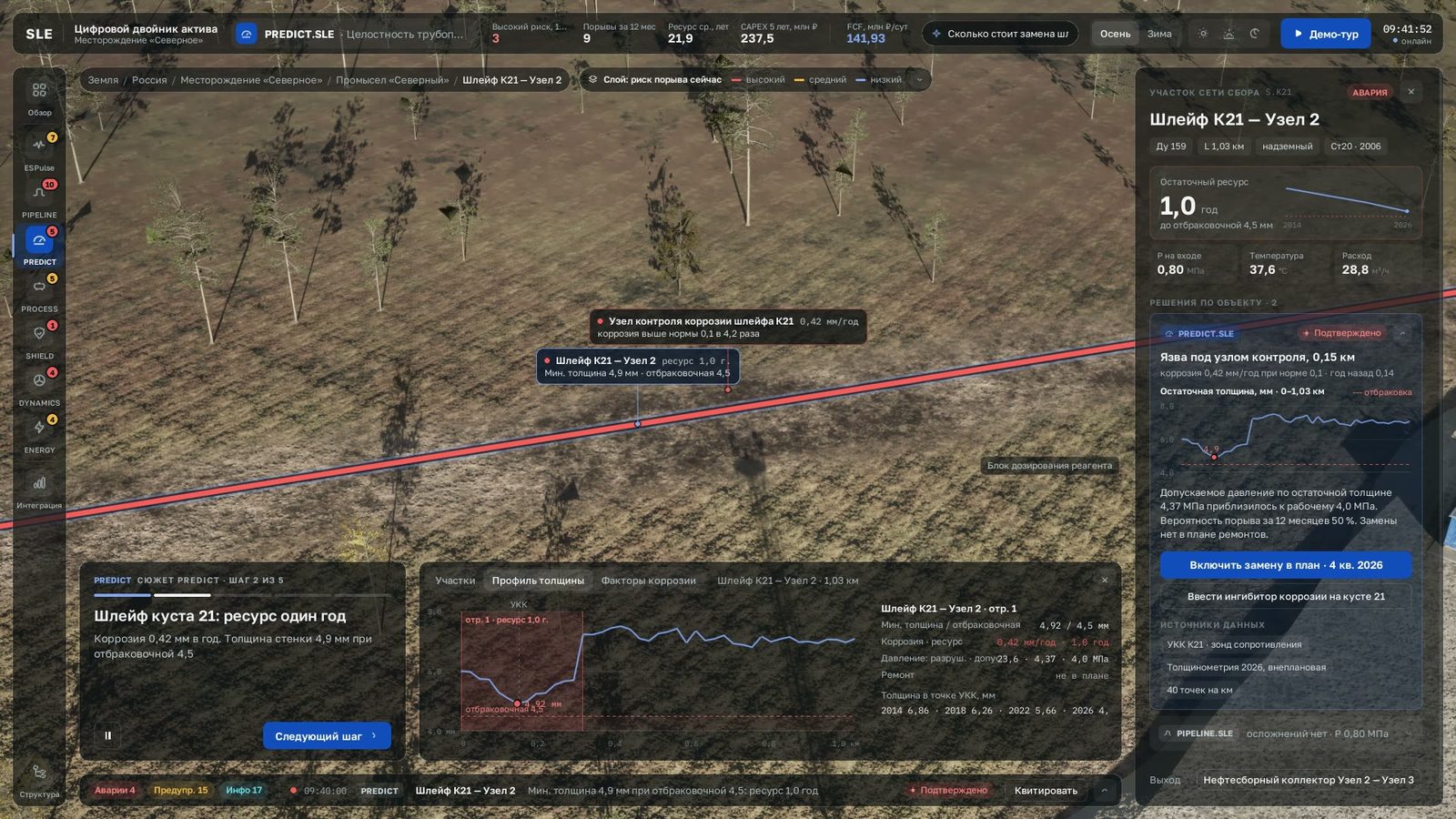
Pad 21 flowline
Corrosion 0.42 mm per year, wall 4.9 mm against a rejection limit of 4.5 — one year of life. Allowable pressure 4.4 MPa against an operating 4.0.
STEP 03
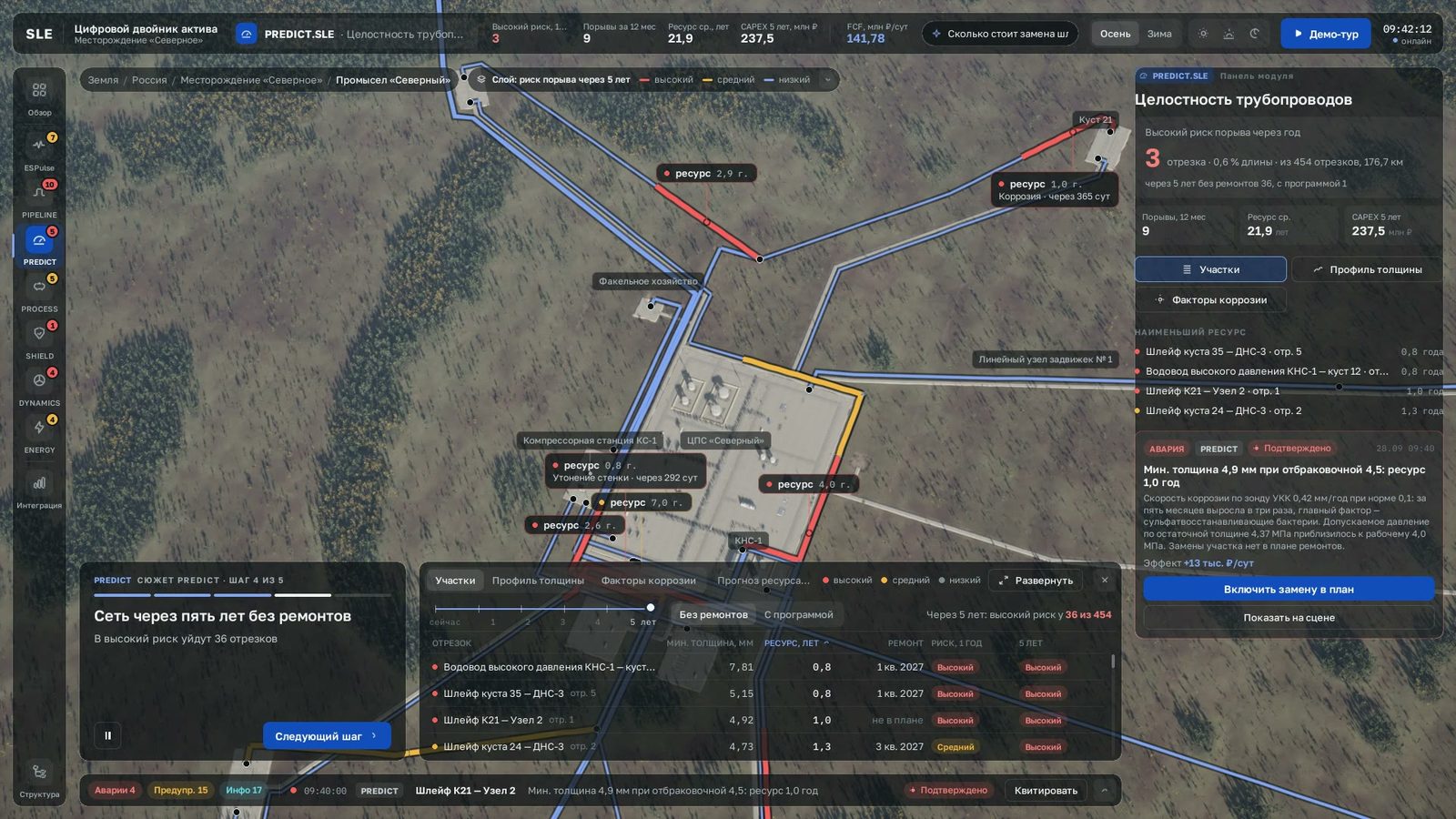
The network in five years
Without repairs 36 sections move into high risk. The flowline replacement goes into the plan — with the repair programme not a single section is at high risk in five years.
Ask the twin
“How much does replacing the pad 21 flowline cost?”
Flowline K21 — Node 2: replacing section 1 (317 m) costs RUB 3.0 mln. Section life 1.0 year, rupture probability within a year 50%; the repair programme has no replacement for it.
An answer with sources; the “Show on scene” button flies the camera to the object.
How it works
01DataIn-line inspection, ultrasonic thickness, corrosion monitoring, modes, ruptures
02ConsolidationRecords and thickness profiles by section
03ModelCorrosion rate, remaining life, allowable pressure
04HorizonThe network in 1–5 years: without repairs and with the programme
05PlanReplacements with timing and cost, CAPEX by year
Capabilities
Risk by section
Every section of the network is coloured by rupture probability; ruptures over 12 months and high-risk sections in the header.
Thickness profile
Remaining wall thickness along the section against the rejection limit.
Corrosion factors
Bacteria, water at the bottom of the pipe, flow velocity — what exactly wears the pipe.
Horizon slider
The network in 1, 3 and 5 years without repairs and with the repair programme.
Replacement economics
The cost of replacing a section and of the whole programme, CAPEX by year.
Matching inspections
In-line inspection and ultrasonic thickness surveys of different years on one section axis.
Regulatory compliance
Grounds for extending service life based on actual condition.
Business effect
up to 40%
fewer ruptures across deployments
estimate across projects
5–10 years
horizon of the replacement investment programme
case · pipeline replacement programme
100+
parameters per section, 5 years of data depth
case · oil and gas gathering system
Case figures were obtained in pilot operation and deployments at specific facilities; “demonstration on the twin” values come from the storyline at the model field.
Use cases
- Integrity engineer sorts sections by remaining life and forms next year's repair plan.
- Chief engineer defends a 5-year pipe replacement investment programme with cost estimates and a risk rationale.
- Industrial safety department receives the sections where remaining thickness approaches the rejection limit.
Integrations
In-line inspection and ultrasonic thickness systems, corrosion monitoring, DCS and data acquisition systems, GIS, production accounting; one network model with PIPELINE.SLE and SHIELD.SLE.
Cross-cutting chains
- PIPELINE.SLE — Operating mode of the same section
- SHIELD.SLE — Rupture or tap: two views of one object
- Article: what an asset digital twin is and where to start →
Case studies and materials
All case studies →From frequent ruptures to a life forecast for every section
100+ parameters, 5 years of data
View case →A 5–10-year pipeline replacement investment programme
life-cycle cost
View case →The solution explained on real projects
SLE engineers show how PREDICT.SLE works on data from an operating asset.
Register →We will show PREDICT.SLE on your asset's data
A demo online or on site; then a pre-project survey of one facility and pilot operation with a measured effect.