Pipelines
SHIELD.SLE — detection of leaks and illegal taps
We see leaks and taps from 0.5% of flow and tell them apart from transients.
SHIELD.SLEA module of the Solution Line Engineering ecosystem: it runs on the single asset model together with the other solutions and is linked to them by one data chain.About the digital twin →
Problem
Illegal offtakes and small gradual leaks hide behind normal pressure losses, pump switch-overs and telemetry noise. Patrols and threshold alarms do not see them, and the losses pile up for months.
Solution
SHIELD.SLE balances the pipeline inlet against the outlet on a dynamic hydraulic model, analyses event signatures, tells a leak from a transient, pinpoints the chainage to ±150 m and keeps an event log with statuses — from detection to confirmation by the field crew.
What the solution sees
One storyline at the demonstration field
STEP 01
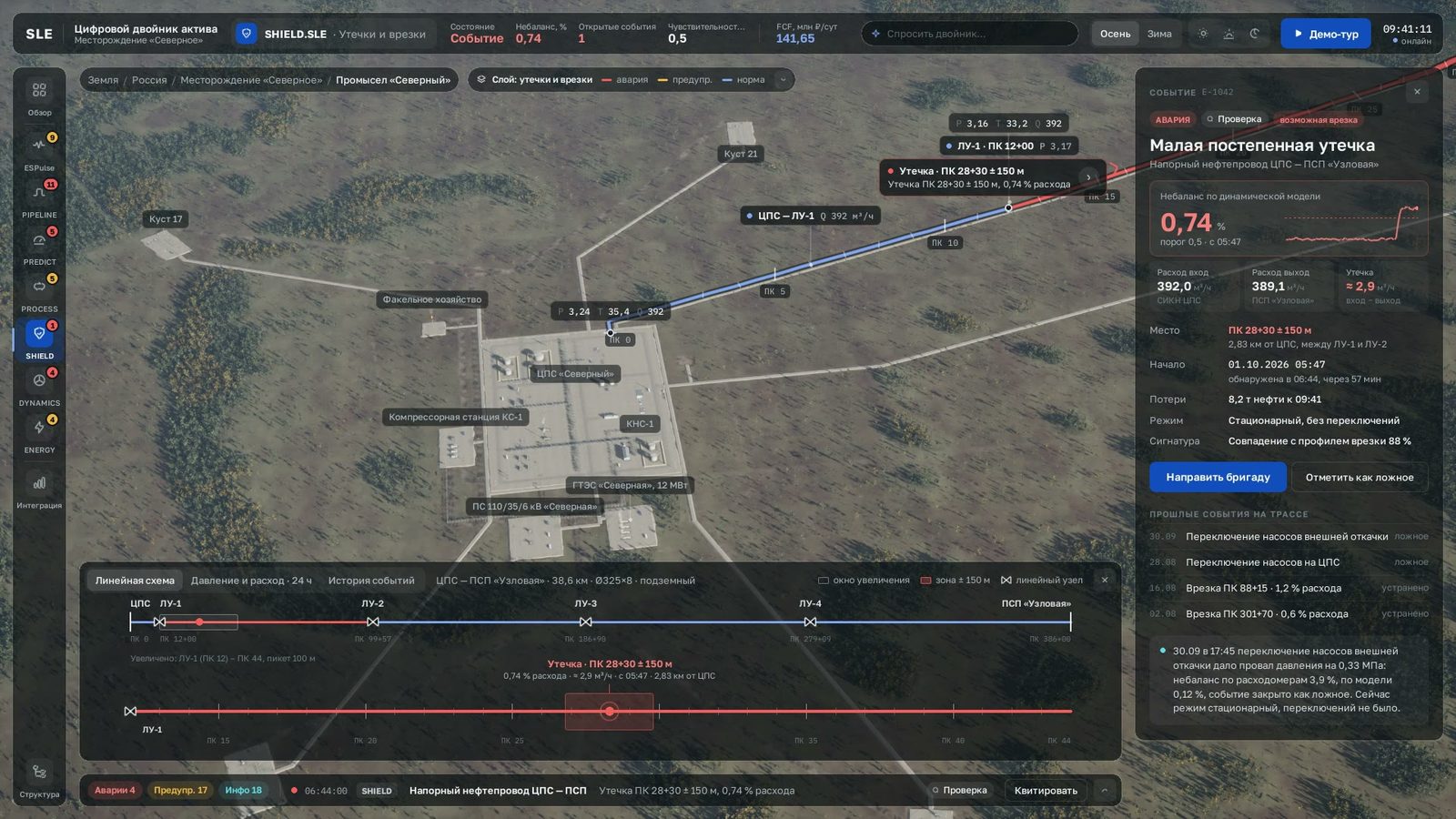
A small gradual leak
The pipeline outlet is 2.9 m³/h short of the inlet — 0.74% of flow. The twin points to the spot: chainage 28+30 ± 150 m, 2.83 km from the CPF.
STEP 02
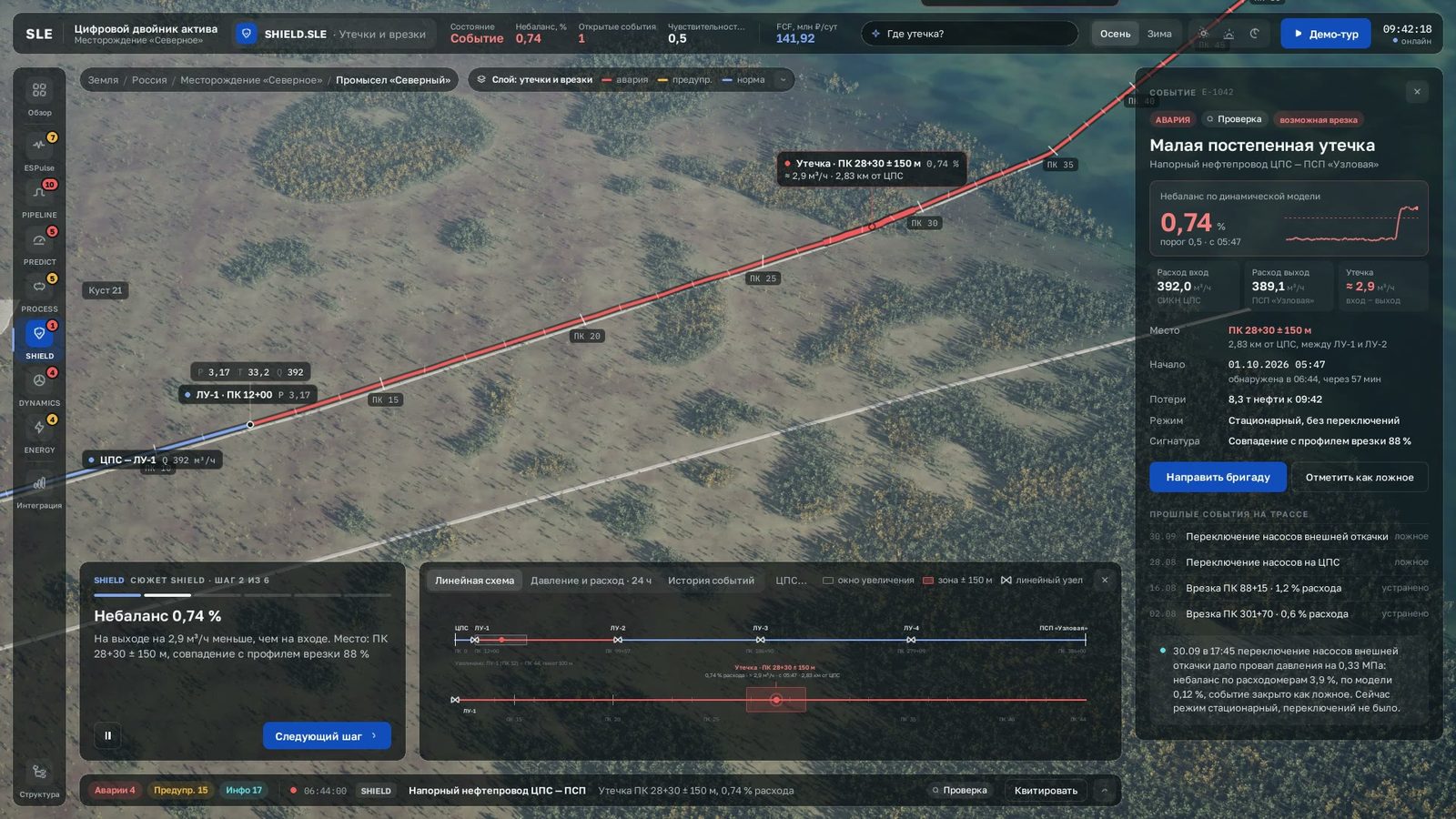
Not every pressure drop is a leak
During the pump switch-over the pressure dip was stronger, but the model classed it as a transient. The event signature matches the tap profile at 88%.
STEP 03
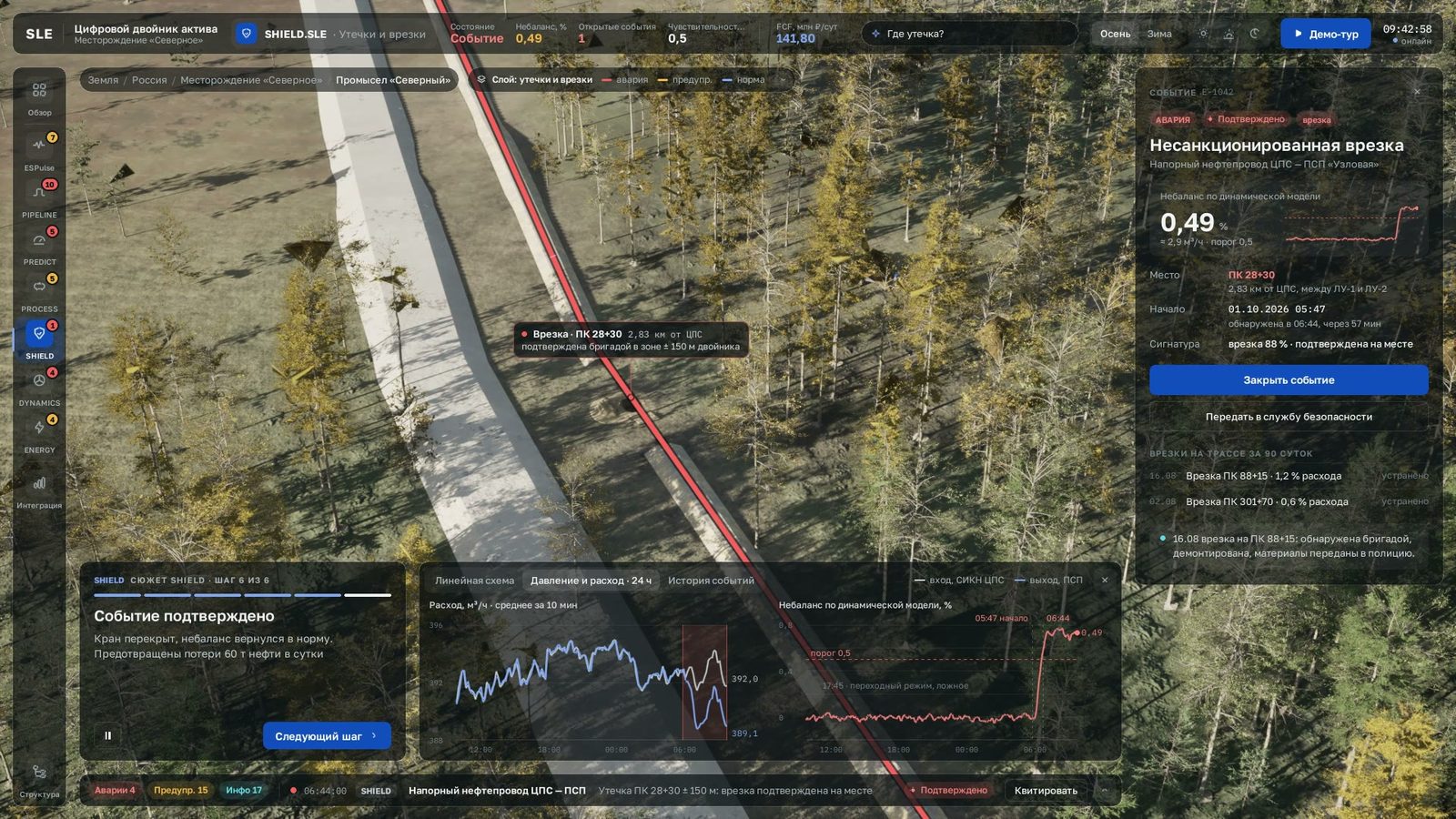
Tap found
The crew drives to the coordinates: a pit above the pipe, a clamp with a valve and a hose to a tanker truck in the forest. The valve is closed, the imbalance is back to normal — losses of 60 t of oil per day prevented.
Ask the twin
“Where is the leak?”
A leak on the export oil pipeline: chainage 28+30 ± 150 m, 2.83 km from the CPF. Imbalance 0.74% of flow, about 2.9 m³/h; the signature matches a tap at 88%.
An answer with sources; the “Show on scene” button flies the camera to the object.
How it works
01DataPressure, flow and temperature along the route
02ModelDynamic hydraulics in real time
03AnalysisEvent signature, transient filter
04LocalisationChainage and uncertainty zone on the route
05Under reviewCrew to the coordinates, confirmation, statistics
Capabilities
Real-time imbalance
Sensitivity from 0.5% of flow; events are seen in the inlet–outlet balance and the pressure at line valve stations.
Event signatures
Pump switch-overs and mode changes do not raise false alarms: the model recognises the transient.
Localisation
Event location to ±150 m, distance from the CPF, nearest line valve station.
Event card
Start time, loss estimate, operating mode, signature, match with the tap profile.
90-day log
Events with statuses: under review, confirmed, false, resolved.
Crew dispatch
Coordinates and a route to the spot; confirmation closes the event and keeps the statistics.
Business effect
from 0.5%
of flow — detection sensitivity
case · interfield oil pipeline
2 taps
found and removed on one route
case · interfield oil pipeline
±150 m
event localisation accuracy
demonstration on the twin
Case figures were obtained in pilot operation and deployments at specific facilities; “demonstration on the twin” values come from the storyline at the model field.
Use cases
- Dispatcher receives the event “leak at chainage 28+30, 0.74% of flow”, sees a steady-state mode and dispatches the crew.
- Pipeline security service reviews the log: confirmed taps, false alarms, resolved leaks.
- Chief engineer reviews the sensitivity setting after model calibration.
Integrations
Pipeline telemetry (DCS / SCADA, pressure and flow sensors), dispatch systems; one network model with PIPELINE.SLE and PREDICT.SLE.
Cross-cutting chains
- PREDICT.SLE — Corrosion and a leak on one object
- PIPELINE.SLE — Operating mode of the export pipeline
- Article: what an asset digital twin is and where to start →
We will show SHIELD.SLE on your asset's data
A demo online or on site; then a pre-project survey of one facility and pilot operation with a measured effect.